Jarkko Sakkinen
jarkko
I'm specifically not interested on "how to program proc macros tutorial". At this point more about "geometry" and how they link and in essence all bin related info.
#rust #cargo #macros
 3
3
 0
0
 2
2
Jarkko Sakkinen
jarkkoLast fix: https://github.com/puavo-org/tpm2sh/commit/3627530516fdcc8739b3c7aea6fab6a136201bfa
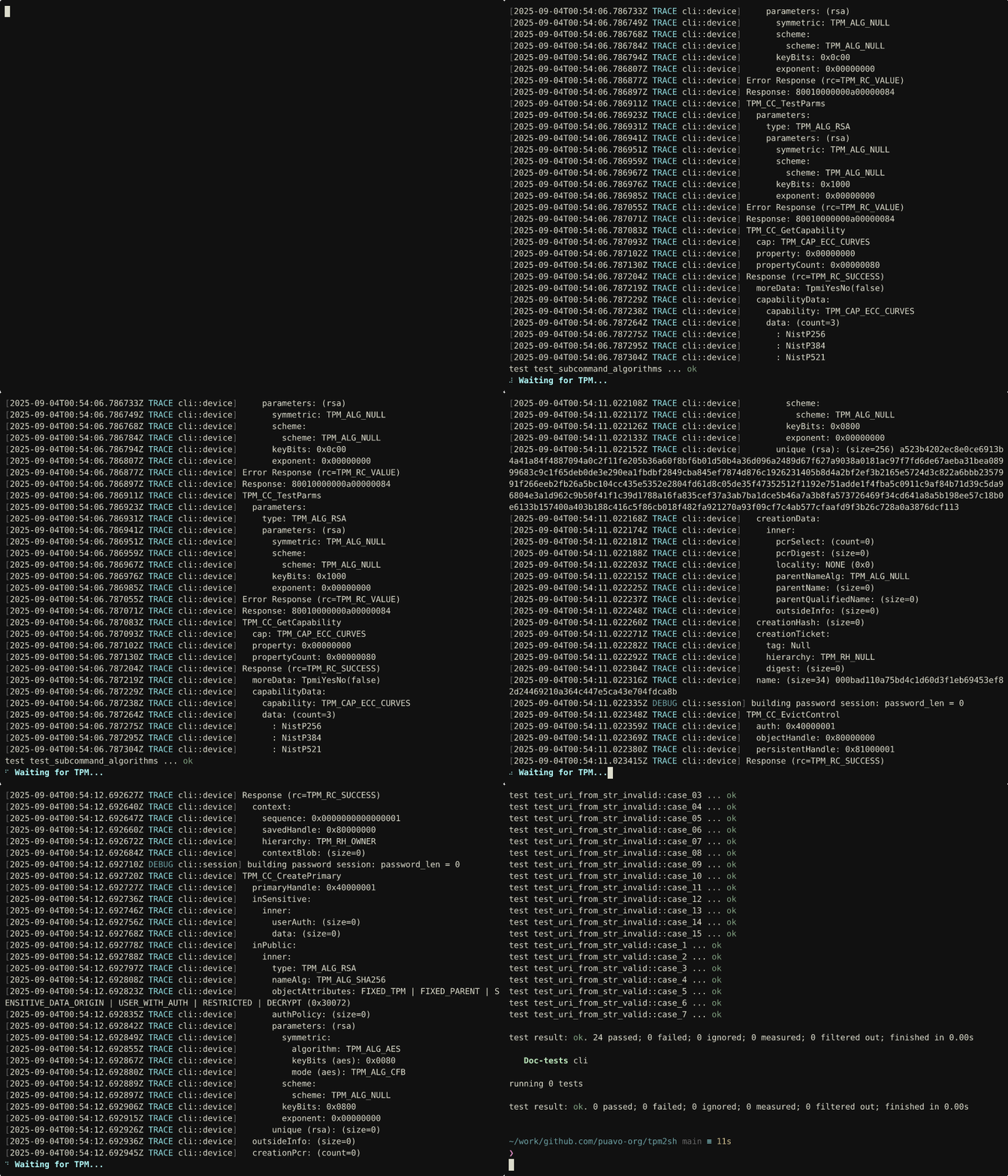
It's a bidirectional test where both the client and the emulator are based on tpm2-protocol. The other side sends commands and parses responses, and the other side send responses and parses commands.
Given the fair amount of software crypto involved to perform any possible bidirectional handshake it is shows off pretty well how robust the implementation is.
#rust #tpm #linux
 0
1
2
0
1
2
Jarkko Sakkinen
jarkko❯ sudo target/debug/tpm2sh algorithms
ecc:bn-p256:sha256
ecc:nist-p256:sha256
keyedhash:sha256
rsa:2048:sha256
it queries the hardware correctly and for RSA it also runs TPM2_TestParms to verify the bit sizes. it was surprsingly hard to get this right but i'd guess this might be even most accurate tool on doing this task (not because it is great but because available software sucks).
0
0
0
Jarkko Sakkinen
jarkkoThe problem I run every single time with clap is how hard it is to control if you actually want to control in detail.
Now I found the ultimate compromise for my situation:
1. I pre-rendered from clap usage and help to usage.txt and help.txt for each subcommand.
2. I changed my subcommands as directories. E.g., from "create-primary.rs" to "create-primary/mod.rs".
3. I deployed the text files to associated directories.
4. Finally I migrated parsing back lexopt.
Intial commit:
59 files changed, 538 insertions(+), 521 deletions(-)
Not too bad. WIth only parsing is just super complicated tool to do that task, or more complicated than necessary, and lexopt adds visibility to code paths so it is overall much more maintainable :-)
Also few redundant edits every once in a while to two txt files per subcommand is IMHO much more maintainable than adjusting generation from the source code.
1
0
0
Jarkko Sakkinen
jarkkohttps://git.kernel.org/pub/scm/linux/kernel/git/jarkko/tpm2-protocol.git/commit/?id=f5e0e82aaad3135be73c3f7a35aaec08e78cfe7c
I.e. if a command or response acts weird the dump can be put either "response.txt" or "command.txt" and roundtrip parse-build-compare will be peformed when running either "cargo test" or "make test".
1
0
0
Jarkko Sakkinen
jarkkohttps://lore.kernel.org/tpm-protocol/20250902165455.3680143-1-jarkko@kernel.org/
Fixed in https://crates.io/crates/tpm2-protocol/0.10.21
Once MockTPM is mature enough I use it also as the unprivileged default backed for tpm2sh.
That enabled two useful features:
1. Dry-run TPM operations with tpm2sh against swTPM with support also for e.g. persistence.
2. Windows and macOS support! They just compile out device parameter and use MockTPM unconditionally.
#linux #rust #tpm
1
0
1
Jarkko Sakkinen
jarkkoI have now a single unified expression language in tpm2sh, which is used in all PCR and policy commands.
You can e.g., express crazy things like or(pcr("sha256:0"), secret(tpm://0x40000001)) with it for instance.
I’ve replaced three separate pest parsers with a single unified nom parser. So much manual control was required anyhow so that diff was pretty much +- 0.
1
0
2
Jarkko Sakkinen
jarkkohttps://git.kernel.org/pub/scm/linux/kernel/git/jarkko/tpm2-protocol.git/commit/?h=queue&id=4efa57b484039b8fa9fb41b647b11b623e60fcde
I actually had to re-learn partly how my own software works but it all looks like fairly sound and logical to me :-) Was a good mental exercise really.
#linux #rust #tpm
0
0
1
Jarkko Sakkinen
jarkkoHad to do the cli extremely wrong, unintuive and pain to maintain to discover what would be actually right in this case. No one has really ever though how to make TPM2 nice to use from command-line so this part of the process :-)
1
0
0
Jarkko Sakkinen
jarkkohttps://bsky.app/profile/linuxfoundation.org/post/3lxu6seyxzc2m
0
0
0
Jarkko Sakkinen
jarkkoIn the current stable (0.10.x) memory interaction can be broken down as follows:
1. There is no internal buffering, meaning that internal state does not consume stack.
2. The result is stored in stack.
In the next version (0.11.x) the memory semantics reduce into:
1. Like in the previous version no internal buffering.
2. There's neither parsing nor building. The macros generate a set of interfacs and all parts can be observed with a set of macro generated traits. This builds on the foundation of the DSL developed for describing TCG specs.
I.e. absolutely minimum requirements to run it are:
1. ROM
2. CPU or microcontroller with reasonable register space.
0
0
0
Jarkko Sakkinen
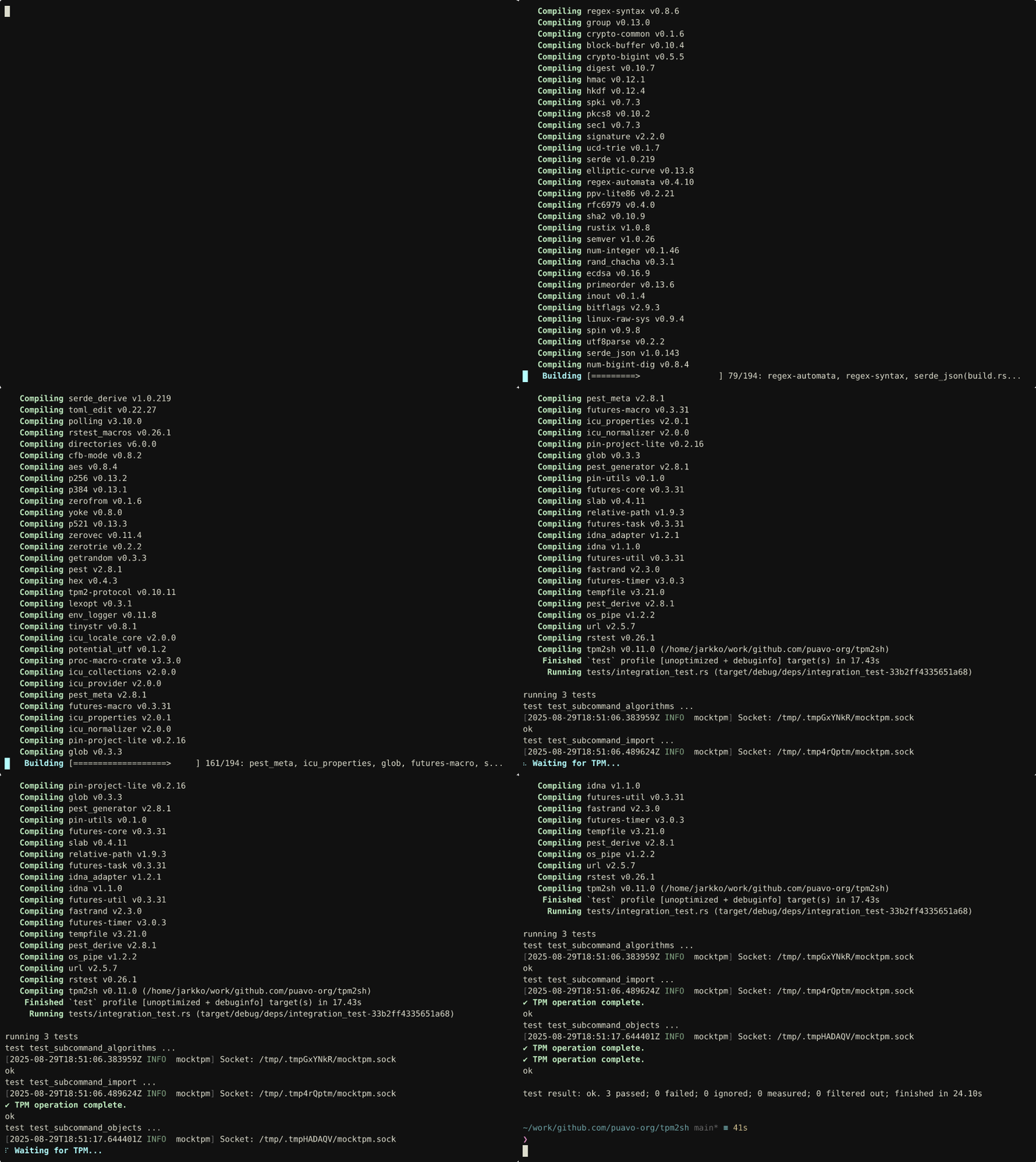
jarkkoNow that I don't do active development on tpm2-protocol, I'm going to make the first actually somewhat stable 0.11.0 release of tpm2sh.
It has quite verbose interface, which will break also easily for that reason. Thus, before pursuing seriously to the possible bugs, I developed MockTPM, a simple TPM emulator that is used as the "TPM end" for subcommand integration tests..,
#linux #kernel #rust #tpm
 0
0
0
0
0
0
Jarkko Sakkinen
jarkko
0
0
1
Jarkko Sakkinen
jarkkoWith TPM protocol shenanigans people tend to go generation path because writing all data types manually would be ridiculous amount of work.
By creating DSL with macros, "ridiculous" factored down to "huge" but only for the initial pass i.e., to reach the current TCG standard version. And given that I have now efficient DSL, keeping the implementation up to date is almost cost-free. And since none of the compiled code is a generation artifact, it is easy to "shift away" in selected places, and write down traits manually.
1
1
1
Jarkko Sakkinen
jarkkoI’m working on a bash and Makefile based project called “himmelblau-dev”, which provides low-barrier entry point to start contributing to that upstream project. I have not really contributed to that project much because there is no a meaningful edit-compile-run-cycle and that is what I’m resolving with this project.
I’ve taken a lot of trouble to not use containers, not even in the build, because containers always mean looking for problems when translating a development environment from one machine to another.
[To be completely honest, for any possible project I interpret “I have to use a container” into “my solution is going to be a trainwreck”]
Instead, I do the build with a combination of deboostrap and guestfish tricks. The project has makefile targets for running resulting QCOW2 in QEMU, contains a settings file (parser implemented in bash) and automatic download of OVMF images and logic for managing EFI vars file.
It’s a bit like embedded build system centered around a single upstream project.
Layout right now:
❯ tree
.
├── bootstrap
│   ├── settings.sh
│   └── start.sh
├── config
│   ├── debian.sh
│   ├── himmeblau.sh
│   └── start.sh
├── himmelblau.version
├── Makefile
├── qemu.json
├── README.md
└── vm
    ├── qemu.sh
    ├── start.sh
    └── swtpm.sh
I need to fine-tunet his for a while still before I publish it. It’s all GPL3 license as I see no point of using any other license for this.
qemu.json is just my own ad-hoc VM configuration format:
{
  "args": {
    "enable-kvm": true,
    "machine": "q35,accel=kvm",
    "cpu": "host",
    "memory": "4G",
    "rtc": "base=localtime"
  },
  "networking": {
    "user": [
      { "netdev": "user,id=net0,hostfwd=tcp::10022-:22" },
      { "device": "virtio-net-pci,netdev=net0" }
    ],
    "bridge": [
      { "netdev": "bridge,id=net0,br=br0" },
      { "device": "virtio-net-pci,netdev=net0" }
    ]
  },
  "tpm": {
    "enabled": true,
    "tpmdev": "emulator,id=tpm0,chardev=chrtpm",
    "device": "tpm-tis,tpmdev=tpm0"
  },
  "drives": [
    {
      "if": "pflash",
      "file": "OVMF_CODE.fd",
      "format": "raw",
      "readonly": "on"
    },
    {
      "if": "pflash",
      "file": "OVMF_VARS.fd",
      "format": "raw"
    },
    {
      "file": "himmelblau-demo.qcow2",
      "format": "qcow2"
    }
  ]
}