
Posts
48Following
1Followers
301
Multipath TCP
mptcp
Managing an NGINX 🌐 server? While switching to a newer version to benefit from the fancy new major security fixes, don’t forget to enable MPTCP support for your clients’ benefits 😉
Simply add the multipath parameter to the listen instructions in your NGINX config files, e.g.
listen <address|port> multipath
More details here.
 0
0
 8
8
 6
repeated
6
repeated

Yepoleb
yepoleb@fosstodon.orgI just tried multipath TCP on Linux and was surprised how easy it was. The idea was to be able to plug my phone into my Laptop and momentarily boost my download speeds. Because few content servers natively support MPTCP, I used a shadowsocks proxy to tunnel to a VPS. Other than that, all I had to was plug in my phone via USB, enable tethering and disable USB debugging. The necessary kernel options were already set and NetworkManager automatically configured the subflows.
#mptcp #networking
1
2
0
Multipath TCP
mptcpIf you are a sysadmin, feel free to enable MPTCP support on NGINX and any other server side services: no impact on “plain” TCP connections because “plain” TCP requests will trigger the creation of a “plain” TCP socket on the server side when being accepted. MPTCP will only be used when requested by the clients, which are usually the ones benefiting from using MPTCP 🔀.
More details here.
0
3
7
Multipath TCP
mptcpNGINX 🌐 1.29.7 mainline version introduces support for Multipath TCP 🔀 🎉
This comes a bit after two NGINX’s forks – freenginx and Angie – with a different approach, but still with the same way to enable it: simply by adding the multipath parameter to the listen instruction, e.g.
listen <address|port> multipath
More details here.
1
14
17
repeated

Matthieu Baerts
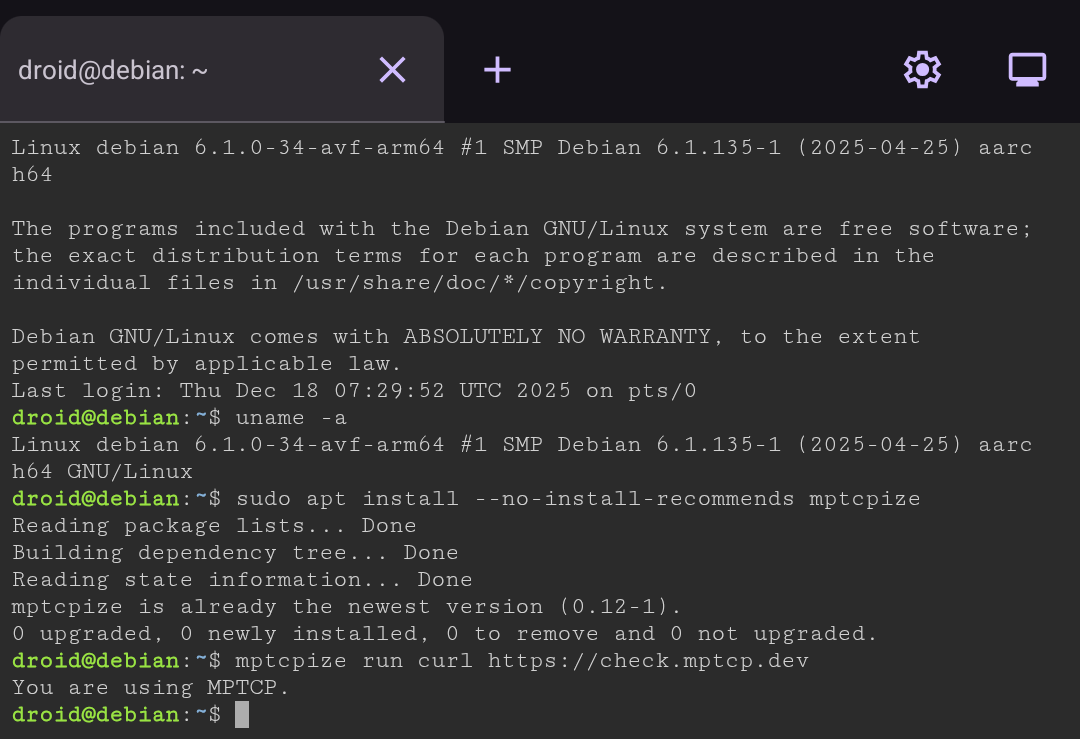
matttbe@fosstodon.orgDid you know you can have MPTCP support with any devices running Android 16? 😯
OK, it is not easily accessible, but using the included Terminal app 🖥️, you can use MPTCP! 🔀
(Android 16 has a Terminal app which runs a full Linux VM with Debian Bookworm and a kernel 6.1 with MPTCP support. Sadly, Google still didn't add full MPTCP support, despite now using kernels supporting it. If you know people who can change that, please contact me 🙂)
 0
1
0
0
1
0
Multipath TCP
mptcpDo you use SSH with MPTCP 🔀 for better resilience in mobility use cases or to increase the throughput? Then, feel free to check the new script to pass to ProxyCommand in the SSH config instead of using mptcpize: https://www.mptcp.dev/faq.html#how-to-enable-mptcp-support-with-openssh
Thanks to @shoragan for having shared this script!
(Hopefully the SSH maintainers will allow one of the suggested (1) (2) native MPTCP support at some points!)
0
13
9
Multipath TCP
mptcp- Better load-balancer deployment support on the client side 🔄
- New 'laminar' endpoints for better controlling addresses signalled by a server 📢
- mptcpd: security review and improvements 🔐
- More apps natively supporting MPTCP 🧑💻
- Misc.: PM, counters, CI, perf, socket options, adaptive ADD_ADDR timeout and future work. 📈
MPTCP or Multipath TCP is an extension to the standard TCP to allow devices to make use of multiple interfaces at once. See https://mptcp.dev for more details.
Thanks to @nlnet for funding part of this work 🎉
#MPTCP #MultipathTCP #Linux
1
10
8
Multipath TCP
mptcpBlog post: https://blog.mptcp.dev/2025/07/14/TCP-in-UDP.html
Code and instructions: https://github.com/multipath-tcp/tcp-in-udp
#eBPF #BPF #TCP #MPTCP
0
5
5
Multipath TCP
mptcp#Traefik is the Cloud Native Application Proxy: https://traefik.io
#MPTCP is short for Multipath TCP, an extension to TCP to make use of multiple interfaces at once to send and receive TCP packets over a single MPTCP connection: https://mptcp.dev
0
6
8
Multipath TCP
mptcp- https://www.mptcp.dev/apps.html
- https://github.com/valkey-io/valkey/pulls?q=MPTCP
#valkey #MPTCP #Redis #Linux
0
1
3
Multipath TCP
mptcpIt would be great if CDNs can support MPTCP 😇
https://www.mptcp.dev/load-balancer.html
#MPTCP #Linux #loadbalancer
0
2
4
Multipath TCP
mptcpv6.15: Single subflow optimisation + prepare PM extension
- Optimise MPTCP performance in single subflow mode by ~29%.
- Expose TCP ULP diagnostic info (MPTCP subflows) to non-admin users.
- PM: a lot of cleanups and preparation work (e.g. new pm_kernel.c file) to allow future extensions
- PM: net.mptcp.path_manager (and net.mptcp.available_path_managers) Sysctl knob deprecates net.mptcp.pm_type
- Misc small optimisations and code coverage
https://github.com/multipath-tcp/mptcp_net-next/wiki#changelog
#MPTCP #Linux #kernel
0
3
9
Multipath TCP
mptcp- Optimize MPTCP performance in single subflow mode by 29%.
🎉
Thanks Paolo for having worked on that!
https://lore.kernel.org/20250326163652.2730264-1-kuba@kernel.org
1
7
12
Multipath TCP
mptcpAll ready to run a transparent proxy to let all clients connected to the router benefit from multiple paths.
https://openwrt.org/releases/24.10/notes-24.10.0
#OpenWrt #MPTCP
0
3
6