
Jason Bowen 🇺🇦
jbowen@mast.hpc.social
I've been out of the loop for a couple of years on Linux phones. I'm poking around on blogs and Mastodon posts, but I figured I'd just ask:
Whats currently (as of January 2026) the most functional, stable, boring phone + OS combination?
Edit: I have been so thrilled with the conversations! Thank you all for sharing projects, experiences, knowledge, and links! I'm also following a lot of new folks :) This post is at 400+ boosts, so no need to continue boosting :)
 30
30
 11
11
 0
0

Robert Mader
rmader@mastodon.social
@jbowen The #pixel3a (if you have that already) with #postmarketos 25.12 Phosh should be a quite solid option, IMO.
1
0
1

David Zaslavsky
diazona@techhub.social@jbowen I'm not sure what the answer is, but I suspect it strongly depends on your position on privacy, so it might be worth clarifying where you stand on that. (like, in one interpretation of this question the answer could be a stock Pixel, if one considers Android as Linux, but I'm assuming that's not what you were going for)
1
0
0
Jason Bowen 🇺🇦
jbowen@mast.hpc.social@diazona Fair point. I'm typing this on a Pixel 10, stock Android, seriously considering GrapheneOS (I've played with it in the past and was too scared to take the plunge for my daily driver).
Privacy is quite the rabbit hole. With this question it's secondary to the user experience of running a "vanilla" Linux kernel with @phosh or some other mobile UI.
I guess one way to think about it is comparing the experience of Linux on a phone to Linux on a laptop.
Are we in a 1998 level of usability?
2
0
0
Daniel Wood
dubstar_04@fosstodon.org@jbowen as far as I am aware there are no mainline linux phones that reliably make calls. There are a number of devices that are very close to having most features working, Oneplus 6, Fairphone 4/5 and Pixel 3a for example.
2026 will be a really interesting year for #Linuxmobile as camera tuning improves and device support becomes more complete.
I'm interested to learn more about how mainline linux devices can implement push notifications to wake the device.
3
1
1
Jason Bowen 🇺🇦
jbowen@mast.hpc.social@dubstar_04
> I'm interested to learn more about how mainline linux devices can implement push notifications to wake the device.
Oh, I didn't know that would be difficult to do. Is it it just the enormous range of hardware and driver quirks?
1
0
0

Guido Günther
agx@ruhr.social@dubstar_04 @jbowen At least the Librem 5 and Pinephone do (I'm using the Liberm 5 for half a decade for that now), both are mainline devices. I don't have first hand experience with a Pixel 3A regarding phone calls but there are people in the Mobian channels using it as their only phone (including phone calls): https://phosh.mobi/about/features/#fn:27 (in this case with suspend disabled).
1
0
0
Jason Bowen 🇺🇦
jbowen@mast.hpc.social@rmader The 3a isn't a device I have, but I'm willing to try to get one :)
Do you mind if I ask if you're using PostmarketOS on a Pixel 3a as a daily driver? If can you both send and receive texts and calls reliably?
1
0
0

⚾️🤌☕🤌KinmenRisingProject-🇹🇼🇺🇦
KinmenRisingProject@g0v.social@jbowen I don't have the possibility to compare different devices, but I can tell you that on the #Pinephone Imho the most stable and functional OS is Sailfish.
1
0
0
Jason Bowen 🇺🇦
jbowen@mast.hpc.social@KinmenRisingProject Do you mind if I ask if you're using that combo as you're daily driver?
1
0
0
Jason Bowen 🇺🇦
jbowen@mast.hpc.social@pilum Do you mind if I ask if that's your daily driver?
0
0
0

Jiří Eischmann
sesivany@vivaldi.net@jbowen I have a Pixel Pro with GrapheneOS and you don't have to be afraid. The only thing that doesn't really work is Google Pay. And IMO it has the best UX/privacy combination at the moment. I also have a OnePlus 6 with PostmarketOS and GNOME/Phosh and although I really like Linux, I can't imagine it as my daily driver now. Out of those non-Android OSes I think SailfishOS on Jolla phone is the most polished option. But it isn't completely open. @diazona @phosh
4
0
0

Hans-Cees 🌳🌳🤢🦋🐈🐈🍋🍋🐝🐜
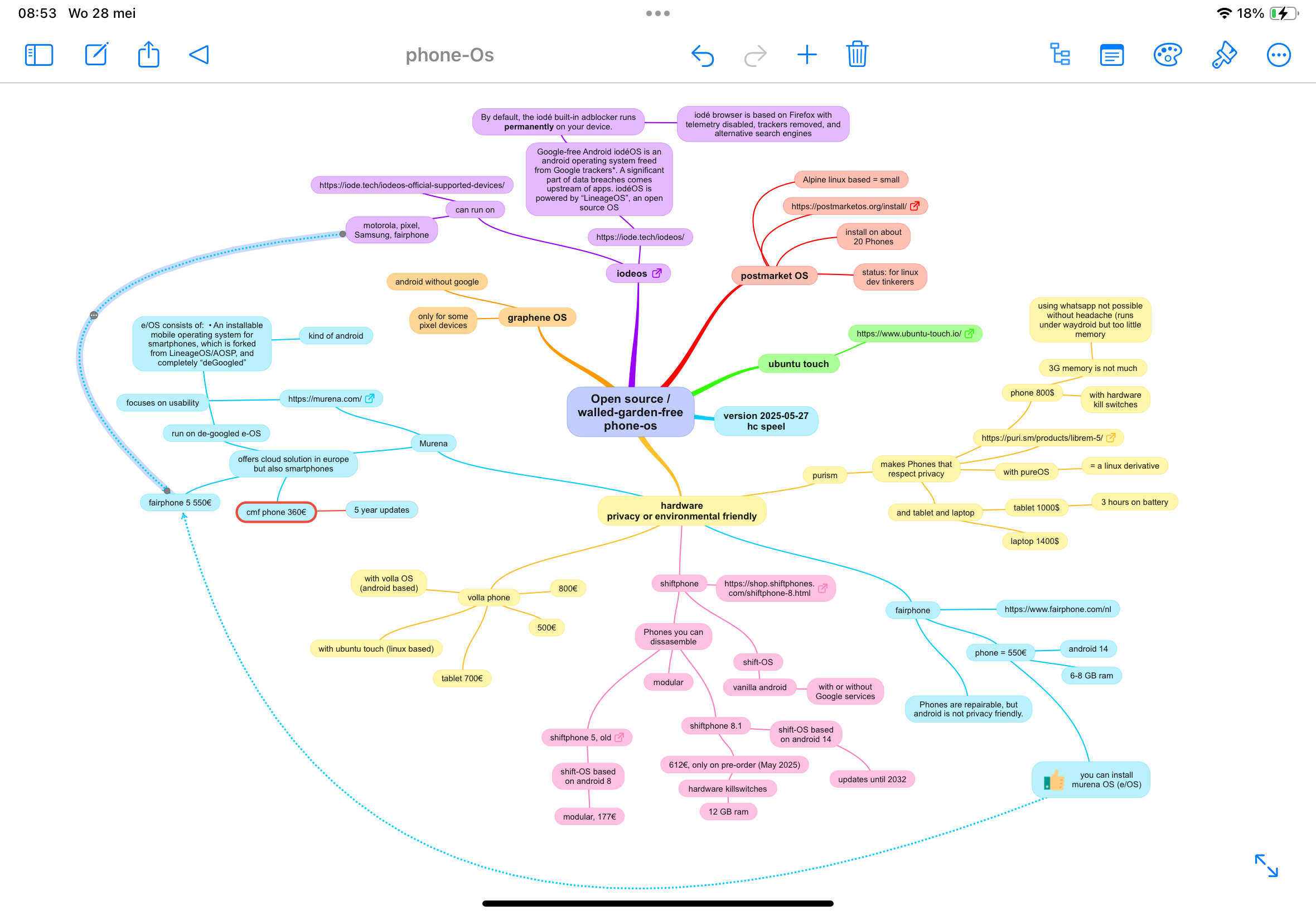
hanscees@ieji.de@jbowen in my mindmap of usable non enshittified phones, (no Google, no Apple) Linux phones are not an option yet for the avarage user.
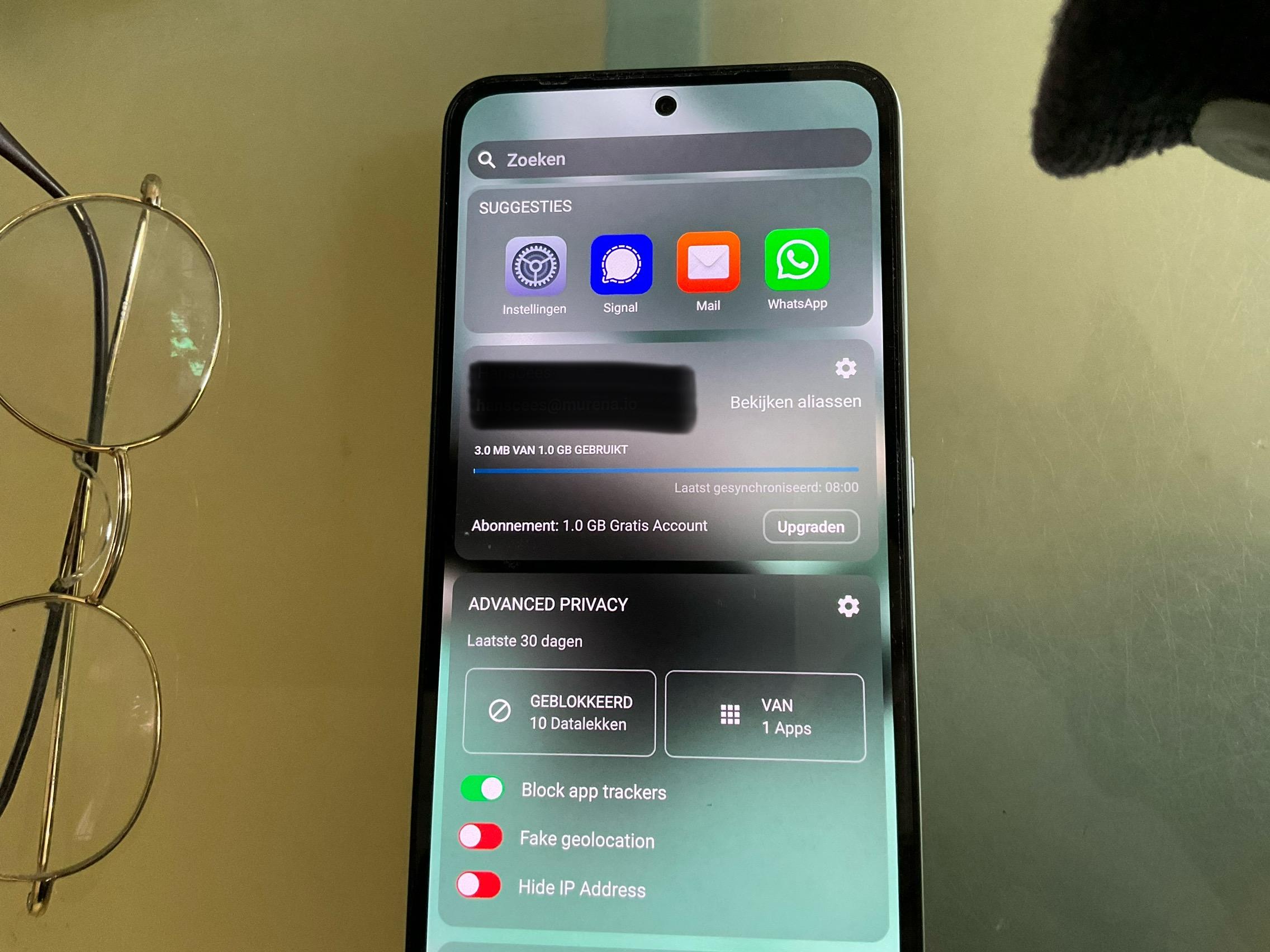
I use murena, which is a nice alternative.
 1
0
0
1
0
0
Jason Bowen 🇺🇦
jbowen@mast.hpc.social@hanscees I'll look up murena. This is the first time I've heard of it. (I also downloaded your mind map to review when I get to a larger screen :)
1
0
0

the esoteric programmer
esoteric_programmer@social.stealthy.club@jbowen There are some companies which refurbish android phones, then put linux on them, there's a compatibility layer with that, helium or something, I forgot how it's called, one of those companies is called fury labs. Because those phones were initially android, and also because those didn't come from a single brand originally, they will have a bit sturdier hardware. As for phone level distros, I would recommend postmarket OS, I'm hearing from people that it's a good distro.
Note: Because screenreader accessibility on linux mobile doesn't exist properly yet, as in it works with a keyboard but the touchscreen doesn't have the proper gestures for it, I'm unable to test those myself, however I'm passing along what I know of the situation
1
0
0
Jason Bowen 🇺🇦
jbowen@mast.hpc.social@esoteric_programmer Thank you very much for passing along what you know! The Helium project tickles something in the back of my head...
1
0
0

Martina Neumayer
MartinaNeumayer@mastodon.social@jbowen As for functionality and stability there is C2 + SailfishOS. Is this combo boring? I wouldn't say that. It just works as it should. Especially considering the price of the whole set and its capabilities (you can use native Sailfish/Linux apps together with the android ones), there is nothing to complain about here, and it can be even used as a daily basis device without any problems.
1
0
0
Jason Bowen 🇺🇦
jbowen@mast.hpc.social@MartinaNeumayer By "can be used as a daily basis device," does that include reliably sending and receiving texts and calls?
1
0
0

Toni Aittoniemi
gimulnautti@mastodon.green
0
0
0
gri573
gri573@ieji.de@jbowen
If you're OK with running a downstream android kernel, then Ubuntu touch or sailfishOS have pretty complete hardware support on a couple of devices (see https://devices.ubuntu-touch.io and https://forum.sailfishos.org/t/community-hardware-adaptations/14081 ). SailfishOS has proprietary UI components, and both of these need somewhat custom-developed apps if I understand correctly (although Ubuntu touch might support snaps now?).
There are also a few downstream-but-linux-first devices like the furiphone FLX1/FLX1s (I think there's another one but forgot its name), which I've seen people daily-drive ("seen" refers to "read on social media" here).
The state of mainline Linux on phones has been covered pretty well by other replies in my opinion.
1
0
0
Jason Bowen 🇺🇦
jbowen@mast.hpc.social@gri573 Thank you for the info and links. Was aware of UbuntuTouch, but not furiphone. I'll check it out.
The responses in this thread are definitely great and beyond my expectations!
0
0
0
Jason Bowen 🇺🇦
jbowen@mast.hpc.social@agx @dubstar_04 Thank you for the info and the link! I'm very curious about the chatter in the responses and blog posts about the Pixel 3a and will be pulling on those threads :)
1
0
0

ebrum
ebrum@mastodont.cat@jbowen it's in German, but I watched this video the other day and it gives a nice overview of the topic
https://media.ccc.de/v/9c563ed6-2e77-5ff4-952d-c8272ec126df
The speaker highlights @furilabs
1
1
0
Jason Bowen 🇺🇦
jbowen@mast.hpc.social@sesivany @diazona @phosh Thank you very much for sharing your experience. I was hoping we might be just beyond the threshold where there's a usable mainline Linux phone, but seems like that's still a year or two out.
Losing Google Pay is one of the reasons I didn't take the plunge, but I can certainly get along without it. :)
0
0
0
⚾️🤌☕🤌KinmenRisingProject-🇹🇼🇺🇦
KinmenRisingProject@g0v.social@jbowen Basically yes, but I must point out something. 1st at all, I don't get many calls; because of the usual battery issue, I added a power bank. 2nd, I rely on 2g to save the battery; for Internet I connect to the wifi. 3rd the GPS doesn't work in my #pinephone.I also experience sometimes troubles with my carrier, and therefore the devices switches to another one, which leads to connection troubles, but I think it's my own problem.
1
0
0
Jason Bowen 🇺🇦
jbowen@mast.hpc.social@KinmenRisingProject Ah, thank you very much for following up with the caveats! I'm willing/expecting to deal with rough/sharp edges, but that sounds a bit rougher than I have the appetite for at the moment.
0
0
0

@jbowen My answer is a dejected "none of them", at least for what I consider functional. Google has systems now where apps can lock themselves to Google-blessed phones only, and the trend has been very clearly towards even more lockdown. Even if something is OK today, it might get a surprise "security improvement" later. Unless said app is something widespread, it's unlikely to have a crack, so, e.g., some utility apps local to my country that I'd rather not use at all will simply not work.
2
0
0
Jason Bowen 🇺🇦
jbowen@mast.hpc.social@landelare Yeah, I was reading about some of the issues GrapheneOS had with AOSP 16 and its "security" (aka "lock-in") features. Incredibly disappointing for the former "don't be evil" company.
That's why I was expecting the options to be something like the PinePhone or Librem.
I'd really love a NetBSD phone, but we're a ways out from that...
0
0
0
Stewart X Addison
sxa@fosstodon.org@landelare @jbowen microG (https://en.wikipedia.org/wiki/MicroG) can get around a lot of issues with Google proprietary requirements (and also improve the GPS functionality AIUI). I have it on my Jolla handset but I'm trying to keep it disabled unless I really need it for something ...Built as you say that doesn't guarantee anything about any particular app in the future.
IMHO the locking down you're referring to is a good reason why we need to start looking at pushing more in the Linux phone space 🤞🏻
2
0
0
Jason Bowen 🇺🇦
jbowen@mast.hpc.social@sxa @landelare Thank you for the link to the project wiki, and the locking down attempts by Google are what prompted me to start looking again.
0
0
0
Stewart X Addison
sxa@fosstodon.org@landelare @jbowen Seems there's at least some support for doing so based on [1] but unclear how reliable it is. I have one banking app that isn't working even with microG but it's unclear if that's related to Play Integrity or something else because it just falls over and restarts itself...
[1] - https://github.com/microg/GmsCore/issues/2729#issuecomment-2571693830
1
0
0
Jason Bowen 🇺🇦
jbowen@mast.hpc.social@sxa @landelare Subscribed to the issue to see where things go
0
0
0

Lokjo - a European online map
lokjo@mapstodon.spaceThere's the modular Shiftphone (german) which runs ShiftOS, a de-googled android
or Jolla (finland) which uses sailfish to run android apps
https://commerce.jolla.com
1
0
0
Jason Bowen 🇺🇦
jbowen@mast.hpc.social@lokjo Jolla has come up a few times in this thread. I wasn't aware of it before and I've seen mentions of it having proprietary components. I understand living with firmware blobs for the time being, but I'll have to do some digging to see what the proprietary comments are about.
0
0
0

Terence Eden
Edent@mastodon.social@jbowen I'm mostly very happy with GrapheneOS on a Pixel 8 Pro.
You can run a full Linux stack on there, or do most shell things in Termux.
Mostly sensible defaults for the Android side of things - although you can ramp up the paranoia if you want.
1
0
0


mag37
mag37@mastodon.socialGrapheneOS here too, while waiting for a proper Linux phone that just works (or if the society can move away from mandatory appstore apps..).
Used GrapheneOS with playstore since 2020ish, took the dive a few months ago to run it without a google account and just F-Droid+Aurora+Obtainium. Works great! Banking apps, commute/parking apps etc.
1
0
0
Jason Bowen 🇺🇦
jbowen@mast.hpc.social@mag37 @oliversampson @Edent Google Pay is my primary concern, but I can certainly live without it. I tend to do banking on my desktop, so I could live without them (but it sounds like I wouldn't have to).
My only remaining concern is fitness trackers (not from experience, just pessimism)
1
0
0
Robert Mader
rmader@mastodon.social@jbowen unfortunately I don't use it as a daily driver yet and thus can't say much about the reliability, sorry :(
What I can say, though, is that it'll (most likely) be one of the first devices with somewhat calibrated cameras in the coming months (already playing around with that here).
2
0
0
the esoteric programmer
esoteric_programmer@social.stealthy.club@jbowen or was it helix? something something, unsure. O wait, that was the rust vim like code editor, no?
1
0
0
Jason Bowen 🇺🇦
jbowen@mast.hpc.social@esoteric_programmer Helix is definitely a thing and there was some native vim action they said in an issue thread that they weren't going to support, so I stopped looking at it (though I've forgotten what the feature was, now).
I feel like I remember Helium around Android or phones...
1
0
0

Jason Bowen 🇺🇦
jbowen@mast.hpc.social@sammy @Oleksii Yeah, I do still use my phone to call people sometimes.
From the responses it sounds like I'm going to take the plunge and try GrapheneOS as a daily driver.
CC @GrapheneOS
0
0
0
Stewart X Addison
sxa@fosstodon.org@jbowen I'd lean towards Jolla C2 (Sailfish OS) as a true functioning (with full glibc) device (Uses rpm packages). It's also quite large if that's any concern/bonus. Also it's from a Finnish company (Not US/China) if that's important to you.
TL;DR No NFC, No biometric auth, camera app is best described as "basic" but on the C2 (and some other devices) you get the Android subsystem to aid transition, and it will run "true" Linux/aarch64 apps e.g. https://fosstodon.org/@sxa/114160876315158082
1
0
0
Jason Bowen 🇺🇦
jbowen@mast.hpc.social@sxa I'm using a Pixel 10 Pro XL :) <3 larger phones :)
I've seen chatter about Jolla/SailFish having proprietary components. Do you have any insight/comment on that topic?
(I'm still scrolling through responses and haven't started investigating that yet)
2
0
0

Jarno
jarno@dosgame.club@jbowen well it depends on what you call Linux. There’s pmOS, there’s Ubuntu Touch, etc. My poison of choice is UT right now but I wouldn’t really call it daily driveable. I mean it’s good and close and all but most available hardware is out dated and you’re missing out on a lot of apps. (As a side phone it’s super!)
1
0
0
Jason Bowen 🇺🇦
jbowen@mast.hpc.social@jarno I'd be willing to put up with outdated/underpowered hardware if something could reliably send/receive texts and calls
0
0
0

TiTiNoNero
77nn@goto.77nn.it@jbowen
I am betting on Jolla Phone with Sailfish OS 5, but haven't seen it yet.
1
0
0
Jason Bowen 🇺🇦
jbowen@mast.hpc.social@77nn Following the responses in this thread I'll be checking out the Jolla C2
0
0
0

El conde nadie
ferrebam@social.gorritodeplata.xyz@jbowen
Well, the truth is that, if you are interested in security, the best thing would be to go to GrapheneOs but it only works with Pixel.
I find myself on the opposite path, fleeing from Android / ios to go to Linux with Jolla.
1
0
1
Jason Bowen 🇺🇦
jbowen@mast.hpc.social@ferrebam I'd like to get as close to vanilla Linux as possible. I'll be checking out Jolla after the responses in this thread
0
0
0
Martina Neumayer
MartinaNeumayer@mastodon.social@jbowen Yes, of course. C2 is an fully functional phone. Moreover, you can install on it few different systems, like SailfishOS, Postmarket, or some degoogled android. I think there's also a port of Ubuntu-Touch for it. But I am not sure about this particular one.
Here's an nice review of the device and Sail:
https://youtu.be/ROOubWeuNs4?si=I8B4_v6iaGXRSdSR
1
0
0
Jiří Eischmann
sesivany@vivaldi.net@jowodo https://docs.sailfishos.org/Develop/Open_Source/
Why is that, I don't know. AFAIK they kept their UI proprietary in the past, it may be open source now, but there are other closed source bits, maybe out of necessity.
0
0
0

mag37
mag37@mastodon.socialI've never used Google Pay (never used any digital payment really except for the Nordic Swish) but I've got two banking apps which works fine. Fitness Trackers I've only tried Strava which works.
There's this list that seems to be kept up to date:
https://privsec.dev/posts/android/banking-applications-compatibility-with-grapheneos/
1
0
0
Jason Bowen 🇺🇦
jbowen@mast.hpc.social@mag37 @oliversampson @Edent Oh, I've managed to miss that section of their website. Thank you!
0
0
0

Juhani Lehtimäki
lehtimaeki@snapp.social@jbowen
Jolla and Volla are two companies actively working on modern Linux phones.
Of course, compared to Google Android, they are quite limited but quality seems solid.
1
0
0
Jason Bowen 🇺🇦
jbowen@mast.hpc.social@lehtimaeki The responses in this thread definitely have me curious about Jolla.
0
0
0
Jason Bowen 🇺🇦
jbowen@mast.hpc.social@rmader Ah, I hadn't really thought about the camera... I might have to keep a Pixel around for that
0
0
0
Jason Bowen 🇺🇦
jbowen@mast.hpc.social@TheRiccard Thank you! It's one of the companies I'll be checking out, along with Jolla
0
0
0

Pavel Machek
pavel#linuxmobile "Camera tuning" ? No sir, we are not doing camera tuning at the moment. We are in "it would be cool to have camera drivers", "major pieces of infrastructure are missing" and "oh, people would like to record video?" phases.
For "boring phone", OnePlus 6 + phosh should work.
And yes, people are working on cameras (including me, we can talk at Fosdem), but we are not yet in the tuning phase.
1
1
5

Jason Bowen 🇺🇦
jbowen@mast.hpc.social@bigbrownepaul @pilum Haha, I definitely get it. I went from a Pixel 3 XL to a 5 (they didn't do an XL that generation) and I never fully got used to it
0
0
0
Stewart X Addison
sxa@fosstodon.org@jbowen I think the Sailfish UI is proprietary, and not sure how much of their Android AppSupport subsystem is fully OSS given that it's not available for all devices that can run Sailfish.
Noting also that the handset is a "Reeder S19 Max Pro S" underneath so cases like https://www.amazon.co.uk/Aroepurt-Compatible-Reeder-Leather-Wallet/dp/B0D426LJWG?th=1 will work with it.
1
0
0
Jason Bowen 🇺🇦
jbowen@mast.hpc.social@sxa Ok, I'll do some digging. Thank you for the pointers.
Even if things are great now with Jolla, I worry about a potential creep towards being more proprietary (a la Google) over the course of years (perhaps with leadership changes, etc)
1
0
0

David Llewellyn-Jones
flypig@mastodon.social@jbowen Thanks @sxa ! I've not read all the replies (there are many!) but always happy to opine on the topic of #SailfishOS.
It's been my main phone OS for many years.
To directly answer your question: Sailfish OS is GNU/Linux, but has some proprietary middleware/UI components. E.g. the Android App Support is closed source. Jolla has recently accelerated its efforts to open other parts:
https://forum.sailfishos.org/t/open-sourcing-proceeding/24689
Separately, this page may be helpful as a launch point:
1
0
0

Chairmander
l_prod@mastodon.gamedev.place@jbowen @esoteric_programmer It's "Halium", basically a middle-layer for running "normal" Linux userspace on an Android kernel. I'm not super familiar with what it all does because I personally am working more on the mainline Linux mobile side of things, but it is a cool project nonetheless: https://halium.org/
1
0
0
Jason Bowen 🇺🇦
jbowen@mast.hpc.social@l_prod @esoteric_programmer That's it! Thank you! I'd completely forgotten about it until this thread
0
0
0
Martina Neumayer
MartinaNeumayer@mastodon.social@jbowen No problem and you're welcome 👍 😊
I did had it for few weeks for testing, but I didn't bought it later. Overall experience was pretty good, but two things I especially needed and they are also a "must-have" for me, which this device doesn't have, prevented me from buying. First one: lack of NFC, and the second one was fingerprint sensor not being placed on the phone's back cover. The rest of the features are really very cool.
1
0
0
Jason Bowen 🇺🇦
jbowen@mast.hpc.social@MartinaNeumayer It's been several years since Google moved to an in-screen fingerprint reader and I've just accepted it. I do miss the reader on the back of the phone. I felt like they were quicker and more reliable.
The lack of NFC kind of sucks, but I can get by without it (I think...)
0
0
0

Raff Karva
RaffKarva@sunny.gardenI’ve spent a while searching, researching and testing.
If you value both security and privacy: Pixel 9 or 10 with Graphene OS;
If you value security and can give up some privacy: latest available iOS (it can be made reasonably private to some extent with a bit of work, but Apple will always log quite a lot of data);
If you value security but don’t care about privacy: Pixel 9 or 10 + latest Android;
If you value privacy but don’t care about security: any Linux distro without microG/Google services (beware that you’ll be limited as to which browser/apps you use which means you might be giving up advanced fingerprint protection, sandboxing etc. The OS might be private, but not what you do online. iOS is a less private OS but your online activity in Safari can be more so);
If you don’t care about privacy nor security: anything not mentioned above.
Apart from iOS and Android, you will have to give up paying with your phone.
Banking & 2FA apps are also hit and miss (there’s a website dedicated to GrapheneOS banking apps compatibility).
An online search for “cellebrite os brute force” will return many articles which back up my above claims re security.
I also recommend these links:
https://eylenburg.github.io/android_comparison.htm
*I’m not an expert, I spent months researching for myself, if I got something wrong, please correct me WITH sources from independent experts. Blogposts by e/OS etc devs with misleading/gaslighting claims is not a reliable source.
1
0
0
Jason Bowen 🇺🇦
jbowen@mast.hpc.social@RaffKarva Thank you! I recall the Celebrite findings with GrapheneOS and I was impressed with it.
0
0
0

Hugo Mills
darkling@mstdn.social@jbowen I've got a PinePhone (with PostmarketOS on it), and I have to say -- *don't use it*. The hardware has problems with connectivity. Some time between 10 minutes and a couple of hours after booting, the modem and wifi will stop working, and needs a reboot. It _just_ about works, very frustratingly, as a media player in my kitchen.
My main phone is a Pixel 8a with Graphene, and that's a lot more usable.
1
0
1
Jason Bowen 🇺🇦
jbowen@mast.hpc.social@darkling Thank you very much for sharing your experience with it. I was hoping things might have recently grossed into daily-driver territory, but it sounds like that's still a year or two out at least.
0
0
0

bit
bit@ohai.social@jbowen This is a bit of an ad for tuta, which I don't even use, but I liked the article anyway. The focus is also degoogled phones, but it still has a lot of overlap with what you asked for, so I'll share it.
1
0
0
Eggs now in different baskets.
the_wub@mastodon.social@jbowen 1/n It depends on how you interpret "functional", "stable" and "boring". And what you expect from a phone.
I settled with mobian/phosh on my PinePhone and PinePhone Pro. I am used to debian which makes some things easier. phosh seems simpler to me than Plasma Mobile and less flashy.
I have uninstalled the "phone" apps like Geary and installed normal desktop apps (like ClawsMail, Vivaldi, LibreOffice, Thunar) and have the XFCE desktop also installed alonside phosh.
1
0
0
Eggs now in different baskets.
the_wub@mastodon.social@jbowen 2/n The Pro is no longer available which is a bit of a shame as it is significantly faster than the PinePhone, even when running the OS from an SD card.
I installed the trixie version of mobian on an SD card and popped it in my PinePhone and that seems at least as reliable and stable as the bookworm version which is currently installed on the eMMC.
I am now able to make phone calls again using mobian trixie. So I expect I will upgrade the OS on the eMMC soon.
1
0
0
Eggs now in different baskets.
the_wub@mastodon.social@jbowen n/n
I was not sure if the loss of phone call features was a SIM, carrier or software issue so I am glad to find out that it was to do with an OS/app problem rather than that my carrier could/would not support the PinePhone.
I could not get either pmOS or UT to see the SIM card in the PinePhone. UT was OK but not IMO as "tweakable" as mobian/phosh.
pmOS looks more interesting with buttons to actuate UI functions so I might try it again to see if a later version can see the SIM card.
1
0
0
Jason Bowen 🇺🇦
jbowen@mast.hpc.social@the_wub Thank you very much for sharing your experience!
0
0
0
Jason Bowen 🇺🇦
jbowen@mast.hpc.social@kim I would look at @the_wub's response thread here: https://mastodon.social/@the_wub/115842426235145976
I haven't really looked at it since late 2021 with Mobian and things have come a long way since then
0
0
0

thermonuclear small claims
fullfathomfive@aus.social@jbowen I just switched to GrapheneOS from an ancient Android running a custom OS, and I love it so far. It was really easy to install, it runs buttery smooth, and whenever I don't know how to do something it takes a couple of minutes of searching to find the answer. It's the right balance of privacy and low friction for me.
1
0
0
Jason Bowen 🇺🇦
jbowen@mast.hpc.social@fullfathomfive Awesome! The two things the replies to in this thread have me inclined to do are:
1. Install GrapheneOS on my current phone
2. Look at the Jolla C2
0
0
0
Daniel Wood
dubstar_04@fosstodon.orgCamera drivers are working on a number of devices with work ongoing to implement autofocus and tuning files.
Talk on Tuning:
https://fosdem.org/2026/schedule/event/BQJPUP-libcamera-tuning/
Tuning Guide:
https://libcamera.stefanklug.com/docs/tuning-guide/tuning.html
1
0
1
Pavel Machek
pavelThen we can do libcamera based video recording, and then.... probably hw acceleration for encoding and then...
Then we can do tuning.
2
1
3

Sebastian Krzyszkowiak
dos@librem.one@rmader @jbowen We've had a "somewhat calibrated" camera on Librem 5 for years now - it needs to be redone more rigorously as the calibration shots used weren't perfect, but at this point this will be fine-tuning rather than drastic improvement.
I've personally never cared much about the selfie cam though, and I'm not aware of anyone else calibrating that one so far, so it's still something left to do.
0
0
0
Sebastian Krzyszkowiak
dos@librem.one@jbowen If "functional, stable, boring", then clearly Librem 5 with PureOS. Perhaps even too boring, but it's catching up now.
0
0
0

sebulon
sebulon@mastodon.social@sesivany @jbowen @diazona @phosh
I tried PostmarketOS with Phosh last year on a Oneplus 6 and a 6T- the device that's supposed to be the best in terms of price, fuctionality and stability.
And while some things are there I can't recommend it unfortunately, I couldn't even make phone calls reliably.
Needs a bit more time in the oven I'm afraid.
2
0
0

💙🩷💜 Brett [he/him/any]
brettm@swarm.coiloptic.orgsxmo is a great and super lightweight user interface, not so android-like but will give the best battery life.
(I don't use postmarketOS on a phone, I installed it on a chromebook to use as a tablet)
0
0
0

Miss Behave
MissBehave@mastodon.online@jbowen @agx @dubstar_04 i daily drive a google pixel 3a with #pmos & #phosh since more than a year now, and while the camera is crap, phone calls work flawless for me!
2
0
0
Jason Bowen 🇺🇦
jbowen@mast.hpc.social@MissBehave @agx @dubstar_04
I've been trying to figure it out since this morning, but what is special about the Pixel 3a that seems to make it the ideal Android phone for Linux? Just curious
0
0
0

Andy Wootton
woo@fosstodon.org@jbowen I looked through the options recently. I found things were worse than a couple of years ago. Even Nokia's version of Firefox OS has failed.
1
0
0
Jason Bowen 🇺🇦
jbowen@mast.hpc.social@woo Have you browsed some of the 50+ responses to this message? There's actually quite a growing ecosystem for Linux on phones. It's just at an awkward point where it's close to being usable, but not quite there.
0
0
0
Pavel Machek
pavel
0
0
1
@MissBehave @jbowen @agx @dubstar_04 I can confirm Pixel3A /PostnarketOS phonecalls work fine But I reverted to using iPhone for calls anyway, unfortunatelly. Reason is I can't / lack skill to make incoming calls ringtone AND call audio work at the same time. In-call volume controlls don't work so I have to decide beforehand if I want hearable ringtone and absolutly unacceptably loud call audio, or unhearable ringtone and ok call audio 🙃
1
0
0
Daniel Wood
dubstar_04@fosstodon.org@ati1 @MissBehave @jbowen @agx
You want ringtones AND call volume? 🤣
Have you tried @postmarketOS recently? There has been a lot of work to improve audio routing:
https://postmarketos.org/blog/2025/08/17/callaudiod-wireplumber-project/
Not sure if the benefits of this work have been realised on a device yet.
1
0
0
@dubstar_04 @MissBehave @jbowen @agx @postmarketOS Hey! Have tested it now and it freakin WORKS on v25.12 I mean ringtones and call audio are still on the same "earpiece and speaker" volume control but physical volume up/down buttons on Pixel3A now work both in and out of the phone call. So all you have to do now is to crank vol down a bit with a button before you answer the call Whoa My 1st sim card goes back to where it belongs now 😎️🤟️ And I guess work is in progress for separate vol controlls
2
0
0
Guido Günther
agx@ruhr.social@ati1 @dubstar_04 @MissBehave @jbowen @postmarketOS Regarding separate volume sliders see https://phosh.mobi/posts/role-based-routing/
1
0
0
@agx @dubstar_04 @MissBehave @jbowen @postmarketOS Thanks. Gave it a quick look and first thing I noticed is I don't have all those separate sliders in my mobile settings you say are there since Phosh 0,47. I am on PmOS 25.12 so I should have Phosh 0.51 . . .
 1
0
0
1
0
0
Guido Günther
agx@ruhr.social@ati1 @dubstar_04 @MissBehave @jbowen @postmarketOS You can't skip most of the "how to run" instructions and expect it to work ☺️, see https://phosh.mobi/posts/role-based-routing/#trying-it-out how to enable media roles which is the prereq for any of this to function.
(It's not pick any of those, all steps need to be done until things are enabled in distributions by default, which then makes the post obsolete)
1
0
0
Robert Mader
rmader@mastodon.social@pavel @dubstar_04 @jbowen I'd disagree on most points here:
1. By now we have quite a few more models with at least one working camera. On the qcom side alone we have: Pixel 3a, OP6, Fairphone 4+5, Poco F1, some other xiaomi devices that I forgot - and a few more devices that should be close, like the Pixel 3 and shift6mq. And we can expect the number to raise further, with previously problematic parts like c-phy now working.
...
2
1
1
Robert Mader
rmader@mastodon.social2. For AF there's a working WIP branch for the swISP, so we can expect progress here as well (plus multiple actuators having working drivers now).
3. We already have a working software stack for photos and videos, via Pipewire and Gstreamer. Just start Snapshot or Kamoso. (surely still missing quite a few features)
4. Drivers for ISPs will stay out of reach on many devices - that's why we have the swISP, which is about to turn into a gpuISP by default (likely in the next libcamera release).
...
3
1
0
Robert Mader
rmader@mastodon.social5. Hardware video encoding is already available and working on devices like the OP6. In Snapshot you can turn it on in the settings - it's only disabled by default because of stability issues/bugs (e.g. on the Pixel3a), another area where we can expect improvements in the near future.
...
1
1
0
Robert Mader
rmader@mastodon.social6. With the gpuISP tuning steps like color correction are essentially free regarding performance. I already have a first test set of tuning matrices for the IMX363 applied on my Pixel3a (running libcamera with latest gpuISP patches) - it currently makes the result worse, but you can expect some comparison images soon where this changes :)
Fairphone even gifted a FP4 and FP5 to the libcamera maintainers so they can start doing this kind of tuning.
1
1
0
Robert Mader
rmader@mastodon.socialTL;DR: the time to start playing with tuning is now - and in fact that's what we're doing already :)
1
0
0
Robert Mader
rmader@mastodon.socialP.S.: here's a quick video shot with Snapshot on an OP6 with pmOS edge + libcamera gpuISP, with hw-encoding enabled. There's still a lot to be desired quality-wise - most importantly AF, sensor tuning - but the basics for fullHD video capturing are increasingly in place (edit: the v4l2 encoder certainly also needs improvements).
1
1
0
Pavel Machek
pavelThanks for video. I guess we can agree that it needs working AF first, and then we'll see what else is needed? :-).
1
0
1
Pavel Machek
pavelGpuisp will need to include sensor tuning, correct? It is needed for video capture. And for still image capture, we'll need to capture full-size raw image, bypassing gpuisp, correct? That will get us bayer image.
But now we'll need to transform that bayer image into high-quality jpg. What is the proposal to do that?
Anyway I'm playing with libcamera-based photo taking here -- https://gitlab.com/tui/libcamera/-/commit/7c3c0d04c026d3a4a030fb7882095c028cd4ee8e -- but there's a lot of work to be done :-(.
1
0
1


David Heidelberg
okias@floss.social@rmader @pavel @dubstar_04 @jbowen There is a working camera, but only with downstream drivers. I think only @flamingradian is working on upstreaming drivers. The generic upstream CCS driver I am working on now is still not there (though getting close).
While I agree it is cool to work in parallel, it is good to have a solid basis for the work first (e.g., the mainline kernel side).
0
0
1
@agx @dubstar_04 @MissBehave @jbowen @postmarketOS Ok I have read your audio roles post slowly now, and simply speaking, not to waste your time, is there some walkthrough for dummies? Or say people not familiar at all with linux configuration deamons and stuff? Or should I just wait till next release (I guess) for this to be integrated ...? ;)
1
0
0
@agx @dubstar_04 @MissBehave @jbowen @postmarketOS I do fail at basics (I guess) like "Note1 if you run wireplumber 0.5.13 ..." -> I have no idea which wireplumber I am running nor how to check it. Nor how to install media-role-nodes.conf. So I cloned feedbackd.git but running that "meson setup -Dmedia ..." line from feedbackd directory -> gives me meson: not found Dead end :)
1
0
0
Guido Günther
agx@ruhr.social@ati1 @dubstar_04 @MissBehave @jbowen @postmarketOS Distros have ways to check versions of packages, e.g. on Debian it is `dpkg -s <packagename>`. They also have means to install build dependencies. So if you use your distros command to install the build deps of wireplumber it will pull in meson and you can build the package.
These commands differ between distros so it's best to read up on that.
It's perfectly fine to wait for the next round of releases too though.
1
0
0
Guido Günther
agx@ruhr.social@ati1 @dubstar_04 @MissBehave @jbowen @postmarketOS If you want to dive deeper into this, it is likely easier to jump onto your distros or phosh's matrix channel so we can help more interactively.
If you just want it to work out of the box then waiting until everything is in a stable release is fine too.
0
0
0

ikuturso 🇪🇺
ikuturso@mastodon.social@diazona I guess we should first define what's meant by 1998 level of usability for Linux on a laptop to be able to answer that. I'm thinking @jbowen may be primarily referring to hardware support by open and mainlined drivers. We did already have fairly nice desktop environments for Linux in '98, including KDE 1.
1
0
0

justsoup 
justsoup@mstdn.social
@jbowen @dubstar_04 Push notifications are pretty different from regular notifications. While regular notifications only pop when the device is active, push notifications appear no matter whether the device is active or in suspend. Android has no issue with this because they implement wakelocks and thus can define what allows suspend and wakes from it. Regular Linux does have locks, but what counts isn't well defined. Also, push notifications require a server, which we didn't have for a while.
1
0
0
justsoup
justsoup@mstdn.social
@jbowen @dubstar_04 Another issue is figuring out how to wake the device when it gets a ping from the server, which is hard to do due to the nature of suspend itself.
1
0
0
Jason Bowen 🇺🇦
jbowen@mast.hpc.social@justsoup @dubstar_04 I'm bookmarking your comments to use as a launching point for what I need to read about when I have some time.
0
0
0
Stewart X Addison
sxa@fosstodon.orgSort of related to that, my C2 officially comes with "one year of updates" and you're supposed to subscribe to get further Sailfish updates after that. I don't think that's the case for the version of Sailfish for the Sony Xperia devices though
It's a model that may not sit too well with some people so I felt it was worth mentioning in this thread.
1
0
0
Jason Bowen 🇺🇦
jbowen@mast.hpc.social@sxa I would be willing to pay for ongoing maintenance of it kept the project free from corporate control. Information and software should be free and open, but infrastructure and maintenance do cost money and I'd rather us users help pay for it rather than corporate interests. Sort of a phone co-op
0
0
0

chipiguay - Pablo 😴
chipiguay@hostux.social@jbowen would you mind updating/following up with your findings somehow? I'm interested!
1
0
0
Jason Bowen 🇺🇦
jbowen@mast.hpc.social@chipiguay I'll try to remember! I'm bookmarking this and I'll set a reminder with a link to your post :)
I'll probably be installing GrapheneOS on my Pixel 10 Pro XL as a first step.
The looking at Jolla + SailFish and Furilabs and their FLX1S over the next six months or so. I'm jbowen on a lot of IRC platforms, but primarily hang out on Libera and OFTC if you want to find me there to chat (no pressure, of course)
0
0
0
skry
skry@mastodon.social@jbowen Thank you. What a wonderful reference for the rest of us. I hope you will keep the thread around so others can learn too.
1
0
0
Jason Bowen 🇺🇦
jbowen@mast.hpc.social@skry I have no intention of deleting the thread :)
Perhaps I should have just left it as it was. I felt greedy since it was asking people to boost it when it had already been over 400 times and received a ton of great responses.
I'll certainly be going back to it over the coming months as I look at Linux phones and I hope others find it useful as well
0
0
0
Robert Mader
rmader@mastodon.social@pavel Re 4: Looking really good now 🤞
5. Yeah, I'm betting on a positive feedback loop here - the more stuff works, the more motivated people are to help fixing the remaining issues.
6. AFAICS lens shading, denoising and YUV formats are high on the list for the next steps after the main gpuISP implementation has landed. And I fully agree that YUY2/YUV420 and NV12 would be great to have. Not having the later currently causes an extra conversion/copy when recording in Snapshot.
1
0
1
Robert Mader
rmader@mastodon.social@pavel Hm, why would you not use the gpuISP for taking still pictures? Sure, you can further improve quality with that in the long run - and the upcoming version of libcamera will allow you to choose between gpuISP and raw - but for starters I'd argue it's fine to just use the gpuISP.
1
0
1
Pavel Machek
pavelAnyway, I'm eagerly waiting for gpuISP and autofocus to hit the libcamera tree. [But one is at v10 now, and second I'm not sure what status of focus is, so my guess is that it will take few more months.]
0
0
0
Pavel Machek
pavelAnd "why not use gpuISP at the moment". Well, besides quality, gpuISP only has one output. We need that output for preview. And that means we have photos in BAYER.
Being able to feed libcamera with BAYER data, and saying "Librem 5 back camera took this BAYER, please convert it to RGB in high quality" would be good.
1
0
0
Robert Mader
rmader@mastodon.social@pavel Re "Well, besides quality, gpuISP only has one output. We need that output for preview" - the way how e.g. Snapshot works right now is that it uses the same buffers for preview/viewfinder as well as encoding video or still images.
A proper multi-stream architecture will certainly be nice long-term - but I don't see why we wouldn't just implement that in the gpuISP when we get to that point (so it can have multiple outputs).
2
0
0
Robert Mader
rmader@mastodon.social@pavel P.S.: encoding RGB/YUV to jpeg (or any image/video format) is something best left to the clients, IMO. Those already have plenty of options to do so, such as using #gstreamer, #ffmpeg or other libraries.
1
0
0

kcxt @ MRMCD
cas@treehouse.systems@sebulon @sesivany @jbowen @diazona @phosh I'm hoping this will finally improve over the next ~18 months, work has been pretty stagnant lately since it's so complicated to actually go about finding what causes calls to fail.
We're getting ever closer to having an automated hardware testing platform, which we'll then be able to use to have a consistent environment for testing calls so we can finally start making sense of the different issues and debugging them
0
0
0