
Jarkko Sakkinen
jarkko
Edited 1 year ago
One of the most important things to understand in Vim are @: and @@. After learning them, there is rarely need mapping ex-mode stuff to keyboard shortcuts.
Already plain vim has two languages: the operator language and vimscript. By learning all the cool tricks of the former, it is often case that there is no need to do anything with the latter. Often plugins are installed because of lack of knowledge in the operator-language ;-)
 1
1
 0
0
 2
2
Jarkko Sakkinen
jarkko
Edited 1 year ago
It is marketed as better Docker but the gist for me is that this implements same as WSL2 for macOS!
Why run Linux on macOS? Learning peculiarities of ARM64, testing kernel and for does brain good to try out different things :-) I've learned a lot about syscalls by comparing behavior of Linux and macOS command-line tools.
Why run Linux on macOS? Learning peculiarities of ARM64, testing kernel and for does brain good to try out different things :-) I've learned a lot about syscalls by comparing behavior of Linux and macOS command-line tools.
0
0
0
Jarkko Sakkinen
jarkko
On #macOS least tedious way to run ALSO full #VM's IHMO (I don't care about #Docker): https://orbstack.dev/
#Apple sucks deeply providing #developer experience but this seems make things somewhat usable. Invention in #orbStack is that VM's use bind mounts (i.e. a bit like #WSL2).
In addition it has great preset gallery, got my Fedora up and running within 3 minutes.
#Apple sucks deeply providing #developer experience but this seems make things somewhat usable. Invention in #orbStack is that VM's use bind mounts (i.e. a bit like #WSL2).
In addition it has great preset gallery, got my Fedora up and running within 3 minutes.
1
1
0
Jarkko Sakkinen
jarkko
@backslash Ah, I read your original post again, and apparently got it wrong. My bad, sorry.
0
0
0
Jarkko Sakkinen
jarkko
Edited 1 year ago
@backslash Hmm. In GNOME (Fedora) I just go to keyboard setting, and add 'fi'. After that Super-SPACE just works (in my case at least). I use almost unmodified Fedora latest in my main Linux workstation.
1
0
0

Jarkko Sakkinen
jarkko
Edited 1 year ago
@chrisdenton So I noticed now that replacing rs file with ANSI escape sequence of any kind but long enough makes rustc to throw error dump like the one I got.
E.g.
\1\e[38;5;015m\2uu\1\e[0m\2\1\e[38;2;191;254;33m\2(ins)\1\e[38;5;015m\2uu\1\e[0m\2\1\e[38;2;191;254;33m\2(ins)\1\e[38;5;015m\2uu\1\e[0m\2\1\e[38;2;191;254;33m\2(ins)\1\e[38;5;015m\2uu\1\e[0m\2\1\e[38;2;191;254;33m\2(ins)\1\e[38;5;015m\2uu\1\e[0m\2\1\e[38;2;191;254;33m\2(ins)\1\e[38;5;015m\2uu\1\e[0m\2\1\e[38;2;191;254;33m\2(ins)\1\e[38;5;015m\2uu\1\e[0m\2\1\e[38;2;191;254;33m\2(ins)\1\e[38;5;015m\2uu\1\e[0m\2\1\e[38;2;191;254;33m\2(ins)\1\e[38;5;015m\2uu\1\e[0m\2\1\e[38;2;191;254;33m\2(ins)\1\e[38;5;015m\2uu\1\e[0m\2\1\e[38;2;191;254;33m\2(ins)\1\e[38;5;015m\2uu\1\e[0m\2\1\e[38;2;191;254;33m\2(ins)\1\e[38;5;015m\2uu\1\e[0m\2\1\e[38;2;191;254;33m\2(ins)\1\e[38;5;015m\2uu\1\e[0m\2\1\e[38;2;191;254;33m\2(ins)\1\e[38;5;015m\2uu\1\e[0m\2\1\e[38;2;191;254;33m\2(ins)\1\e[38;5;015m\2uu\1\e[0m\2\1\e[38;2;191;254;33m\2(ins)\1\e[38;5;015m\2uu\1\e[0m\2\1\e[38;2;191;254;33m\2(ins)\1\e[38;5;015m\2uu\1\e[0m\2\1\e[38;2;191;254;33m\2(ins)\1\e[38;5;015m\2uu\1\e[0m\2\1\e[38;2;191;254;33m\2(ins)\1\e[38;5;015m\2uu\1\e[0m\2\1\e[38;2;191;254;33m\2(ins)\1\e[38;5;015m\2uu\1\e[0m\2\1\e[38;2;191;254;33m\2(ins)\1\e[38;5;015m\2uu\1\e[0m\2\1\e[38;2;191;254;33m\2(ins)\1\e[38;5;015m\2uu\1\e[0m\2\1\e[38;2;191;254;33m\2(ins)\1\e[38;5;015m\2uu\1\e[0m\2\1\e[38;2;191;254;33m\2(ins)\1\e[38;5;015m\2uu\1\e[0m\2\1\e[38;2;191;254;33m\2(ins)\1\e[38;5;015m\2uu\1\e[0m\2\1\e[38;2;191;254;33m\2(ins)\1\e[38;5;015m\2uu\1\e[0m\2\1\e[38;2;191;254;33m\2(ins)\1\e[38;5;015m\2uu\1\e[0m\2\1\e[38;2;191;254;33m\2(ins)\1\e[38;5;015m\2uu\1\e[0m\2\1\e[38;2;191;254;33m\2(ins)\1\e[38;5;015m\2uu\1\e[0m\2\1\e[38;2;191;254;33m\2(ins)\1\e[38;5;015m\2uu\1\e[0m\2\1\e[38;2;191;254;33m\2(ins)\1\e[38;5;015m\2uu\1\e[0m\2\1\e[38;2;191;254;33m\2(ins)\1\e[38;5;015m\2uu\1\e[0m\2\1\e[38;2;191;254;33m\2(ins)\1\e[38;5;015m\2uu\1\e[0m\2\1\e[38;2;191;254;33m\2(ins)\1\e[38;5;015m\2uu\1\e[0m\2\1\e[38;2;191;254;33m\2(ins)\1\e[38;5;015m\2uu\1\e[0m\2\1\e[38;2;191;254;33m\2(ins)\1\e[38;5;015m\2uu\1\e[0m\2\1\e[38;2;191;254;33m\2(ins)\1\e[38;5;015m\2uu\1\e[0m\2\1\e[38;2;191;254;33m\2(ins)\1\e[38;5;015m\2uu\1\e[0m\2\1\e[38;2;191;254;33m\2(ins)\1\e[38;5;015m\2uu\1\e[0m\2\1\e[38;2;191;254;33m\2(ins)\1\e[38;5;015m\2uu\1\e[0m\2\1\e[38;2;191;254;33m\2(ins)\1\e[38;5;015m\2uu\1\e[0m\2\1\e[38;2;191;254;33m\2(ins)\1\e[38;5;015m\2uu\1\e[0m\2\1\e[38;2;191;254;33m\2(ins)\1\e[38;5;015m\2uu\1\e[0m\2\1\e[38;2;191;254;33m\2(ins)\1\e[38;5;015m\2uu\1\e[0m\2\1\e[38;2;191;254;33m\2(ins)\1\e[38;5;015m\2uu\1\e[0m\2\1\e[38;2;191;254;33m\2(ins)\1\e[38;5;015m\2uu\1\e[0m\2\1\e[38;2;191;254;33m\2(ins)\1\e[38;5;015m\2uu\1\e[0m\2\1\e[38;2;191;254;33m\2(ins)\1\e[38;5;015m\2uu\1\e[0m\2\1\e[38;2;191;254;33m\2(ins)\1\e[38;5;015m\2uu\1\e[0m\2\1\e[38;2;191;254;33m\2(ins)\1\e[38;5;015m\2uu\1\e[0m\2\1\e[38;2;191;254;33m\2(ins)\1\e[38;5;015m\2uu\1\e[0m\2\1\e[38;2;191;254;33m\2(ins)\1\e[38;5;015m\2uu\1\e[0m\2\1\e[38;2;191;254;33m\2(ins)\1\e[38;5;015m\2uu\1\e[0m\2\1\e[38;2;191;254;33m\2(ins)\1\e[38;5;015m\2uu\1\e[0m\2\1\e[38;2;191;254;33m\2(ins)\1\e[38;5;015m\2uu\1\e[0m\2\1\e[38;2;191;254;33m\2(ins)\1\e[38;5;015m\2uu\1\e[0m\2\1\e[38;2;191;254;33m\2(ins)
works pretty well ;-)
1
0
0
Jarkko Sakkinen
jarkko
@chrisdenton So the file had some corrupted https://github.com/rust-lang/rust/issues/127868
1
1
0
Jarkko Sakkinen
jarkko
@chrisdenton So the file had some corrupted https://github.com/rust-lang/rust/issues/127868
1
1
0
Jarkko Sakkinen
repeated
repeated

LWN.net is now @LWN@lwn.net
LWN@fosstodon.orgSilva: How to use the new counted_by attribute in C (and Linux)
0
3
0
Jarkko Sakkinen
jarkko
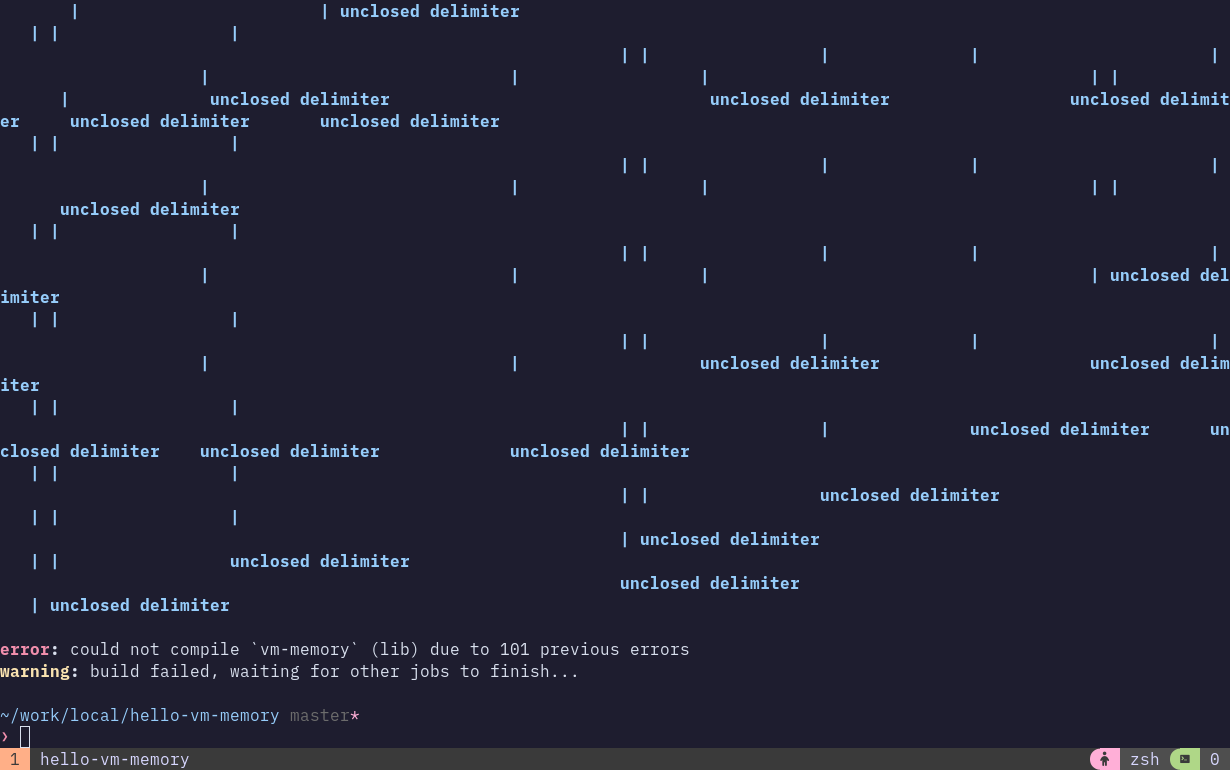
Not a tmux issue, happens with and without, and also nothing to scrollback. It just gives a single screen of garbage as an "error message".
0
0
0
Jarkko Sakkinen
jarkko
Edited 1 year ago
@hjvt I found proper memory mapping primitives from vm-memory, they are just under "xen" feature flag, e.g. https://docs.rs/vm-memory/latest/vm_memory/mmap/struct.MmapRange.html.
I don't get the reason for "xen-only" but the API is reasonable and quick skim to source seems to give same impression.
So I see where that leads me. If possible I'd prefer vm-memory most only because of its volume. I.e. most likely to stay alive and maintained.
I don't get the reason for "xen-only" but the API is reasonable and quick skim to source seems to give same impression.
So I see where that leads me. If possible I'd prefer vm-memory most only because of its volume. I.e. most likely to stay alive and maintained.
1
0
0