Jarkko Sakkinen
jarkko
features that protocol crate can do is to break down any byte stream to either direction into a data type 1:1 matching its internal structure, modify it and turn it back into bytes, which delivers quite robust filtering architecture, which is non-existent in /dev/tpmrm0.
 0
0
 0
0
 0
0
Jarkko Sakkinen
jarkko
Edited 10 months ago
i'd be interested on seeing a new version of /dev/tpmrm0 that would take advantage of my protocol marshaler/unmarshaler.
it's about 5k of rust code but large portion of that is just architectural types.
the first problem is the hardest: what to call the new at this point still imaginary device :-)
it's a post initcall use case just like /dev/tpmrm0 e..g, use by systemd (afaik tbh have not checked) where as hardware interfacing stuff would be tedious given tight bindings to to the boot. thus, it is not extremely hard to implement in linux-rust as long as the device can turn on before PID 1.
benefits could be e.g., to simplify TPM code in daemons such as systemd, if the resource manager would do a better job servicing their requirements.
#linux #tpm #rust #rustlang
it's about 5k of rust code but large portion of that is just architectural types.
the first problem is the hardest: what to call the new at this point still imaginary device :-)
it's a post initcall use case just like /dev/tpmrm0 e..g, use by systemd (afaik tbh have not checked) where as hardware interfacing stuff would be tedious given tight bindings to to the boot. thus, it is not extremely hard to implement in linux-rust as long as the device can turn on before PID 1.
benefits could be e.g., to simplify TPM code in daemons such as systemd, if the resource manager would do a better job servicing their requirements.
#linux #tpm #rust #rustlang
1
0
0
Jarkko Sakkinen
jarkko
Edited 10 months ago
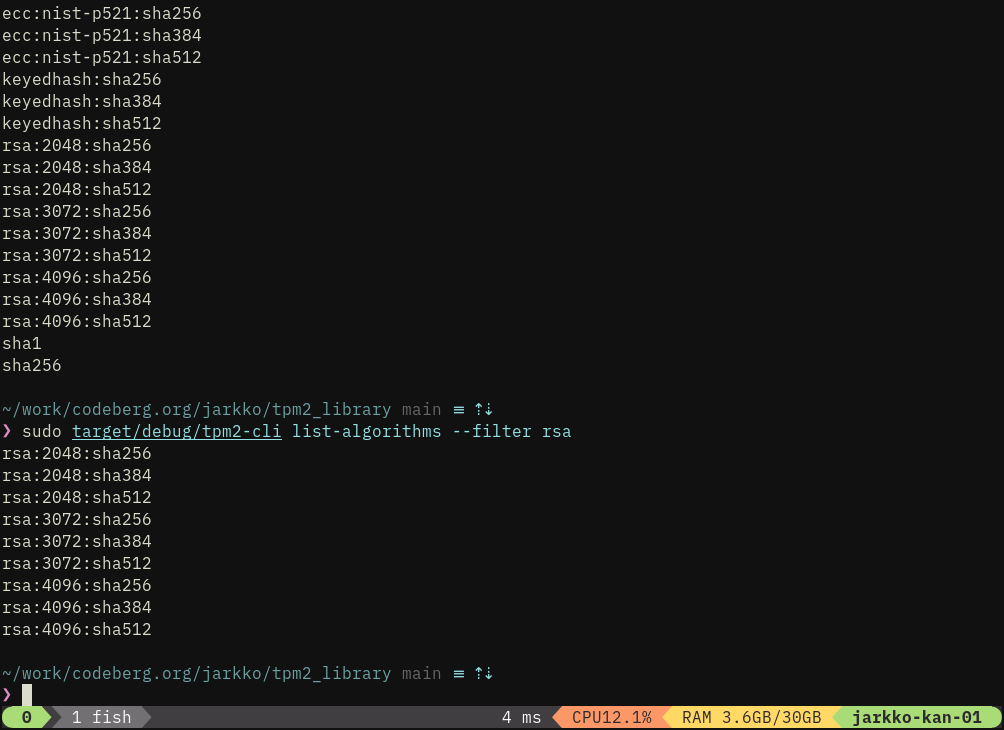
Regex filtered search for algorithms in the TPM chip and the format used for algorithms in tpm2-cli.
Some other idioms are context: and nvram: as sinks for output.
Some other idioms are context: and nvram: as sinks for output.
0
0
0
Jarkko Sakkinen
jarkko
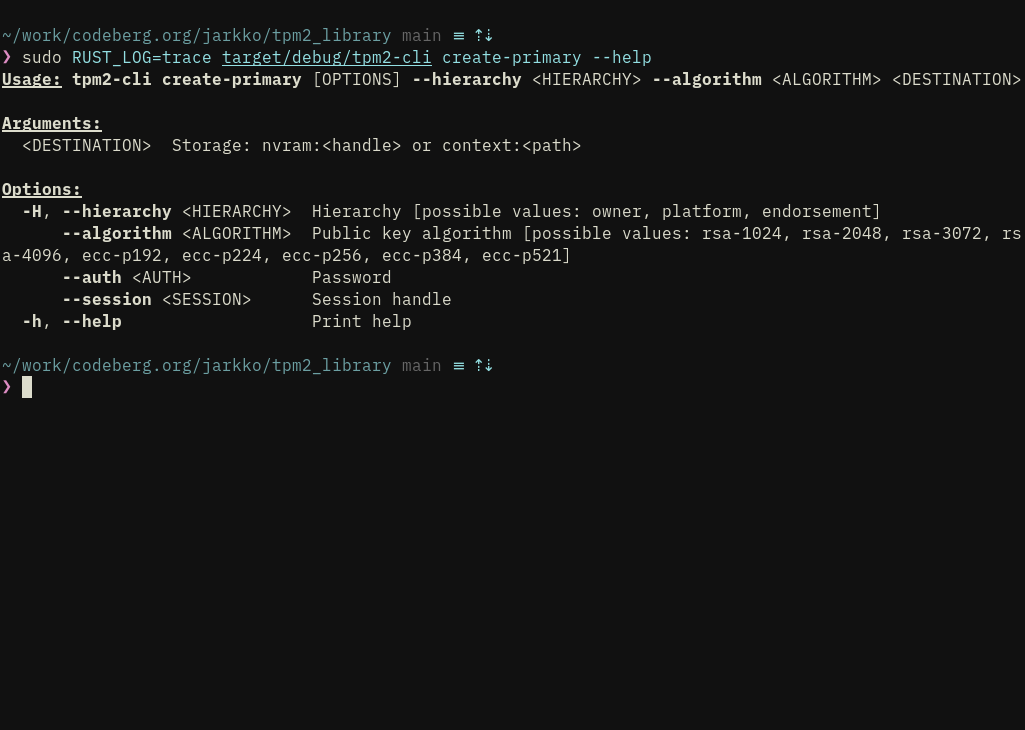
I'm making sure the cli works nicely before pushing to Gitlab for some days. It is at least much saner looking already (IMHO) than tpm2-tools.
0
0
1
Jarkko Sakkinen
jarkko
It's always a good sign when things converge like this :-) I reached unipolarity (can assemble and disassemble to both directions) with the TPM2 architectural structures I've already included (~40% of the spec) in tpm2_protocol.
pub trait Command<'a>: Marshal + Unmarshal<'a> {
const COMMAND_CODE: TpmCc;
const COMMAND_TAG: TpmSt;
}
pub trait Response<'a>: Marshal + Unmarshal<'a> {
const COMMAND_CODE: TpmCc;
const COMMAND_TAG: TpmSt;
}
pub trait Command<'a>: Marshal + Unmarshal<'a> {
const COMMAND_CODE: TpmCc;
const COMMAND_TAG: TpmSt;
}
pub trait Response<'a>: Marshal + Unmarshal<'a> {
const COMMAND_CODE: TpmCc;
const COMMAND_TAG: TpmSt;
}
0
0
0
Jarkko Sakkinen
jarkko
@arj and neither are deps but this also for the stituation if some wants to extend kernel tpm stack to rust side. by the time i have this polished, mature and tested and can give this and say that "this is how i want to protocol parsing work".
i thought that for such extensions there are better people than me to bind io for linux-rust shenanigans but for tpm2 protocol itself i have over decade long expertise and believe that i can solve this particular subproblem better than anyone else ;-)
i thought that for such extensions there are better people than me to bind io for linux-rust shenanigans but for tpm2 protocol itself i have over decade long expertise and believe that i can solve this particular subproblem better than anyone else ;-)
1
0
0
Jarkko Sakkinen
jarkko
@arj i'll release the repository in upcoming days/weeks and rather use the repository for source code for proper licensing platters etc. :-)
as for deps:
bitflags = { workspace = true }
strum = { workspace = true }
I use these for convenience (for now at least) and for the reason that I can eventually remove them :-)
if i want to translate this to kernel there's no cargo.
as for deps:
bitflags = { workspace = true }
strum = { workspace = true }
I use these for convenience (for now at least) and for the reason that I can eventually remove them :-)
if i want to translate this to kernel there's no cargo.
1
0
1
Jarkko Sakkinen
jarkko
@jejb @oleksandr it's possible buf since given how tpm_transmit() works i don't think that is like behaviour. it looks more like if tpm_transmit() was not invoked at all.
0
0
0
Jarkko Sakkinen
jarkko
Imaginary kernel example would be /devtpmrm0 but given ability to break the bytestream apart and put it back together, be it either direction, it could be much more sophisticated than the existing.
0
0
0
Jarkko Sakkinen
jarkko
As secondary priority, I want to have this ready for any linux-rust interactions because it would be the part of implementation I would be most concerned of. That is one reason I've ended up to a context-free and environment agnostic implementation like this.
1
0
0
Jarkko Sakkinen
jarkko
Totally applicable also to be used in pre-boot loaders, operating system kernels etc. as it does what it does efficiently but is io-less (it does things right tho with AsRef and similar traits so to that it melts nicely to io-full world).
1
0
0
Jarkko Sakkinen
jarkko
Edited 10 months ago
tpm2_protocol is turning into quite cool crate:
1. It's a no_std crate that uses Rust's type system describe TPM commands and responses in the same resolution as the spec.
2. It marshals also responses and unmarshals commands.
3. It's not a stack. it's stackless implementation of types.
These properties allow to nest and glue it to TSS2 and any other pre-existing TPM stack.
Also it could be theoretically used to implement a chip since it is designed to run also bare metal and has been designed to be skimpy on resources ;-)
Hopefully next week get this out...
1. It's a no_std crate that uses Rust's type system describe TPM commands and responses in the same resolution as the spec.
2. It marshals also responses and unmarshals commands.
3. It's not a stack. it's stackless implementation of types.
These properties allow to nest and glue it to TSS2 and any other pre-existing TPM stack.
Also it could be theoretically used to implement a chip since it is designed to run also bare metal and has been designed to be skimpy on resources ;-)
Hopefully next week get this out...
2
0
1
Jarkko Sakkinen
jarkko
This is amount of spec types I uncarved from tpm2-scripts and redefined Rust types:
```
creation_ticket.rs
mod.rs
tpm2b_public.rs
tpm2b.rs
tpm2b_sensitive_create.rs
tpm_alg_id.rs
tpma_object.rs
tpma_session.rs
tpm_cap.rs
tpm_cc.rs
tpm_ecc_curve.rs
tpml_digest.rs
tpml_digest_values.rs
tpml_pcr_selection.rs
tpm_rc.rs
tpm_rh.rs
tpms_auth_command.rs
tpms_auth_response.rs
tpms_context.rs
tpms_ecc_point.rs
tpm_se.rs
tpms_keyedhash_parms.rs
tpms_pcr_selection.rs
tpms_pcr_select.rs
tpms_sensitive_create.rs
tpms_symcipher_parms.rs
tpm_st.rs
tpmt_ha.rs
tpmt_kdf_scheme.rs
tpmt_public.rs
tpmt_scheme.rs
tpmt_sym_def_object.rs
tpmu_ha.rs
tpmu_public_id.rs
tpmu_public_parms.rs
```
This is horribly slow process as first because it is not as mechanical process one might think. There's lot of scattered per-type quirks. But as this grows this becomes less and less of pain :-)
I define "completed" status for every type that they must serialize and deserialize, which creates constraints that make them feasible for mock testing for instance.
```
creation_ticket.rs
mod.rs
tpm2b_public.rs
tpm2b.rs
tpm2b_sensitive_create.rs
tpm_alg_id.rs
tpma_object.rs
tpma_session.rs
tpm_cap.rs
tpm_cc.rs
tpm_ecc_curve.rs
tpml_digest.rs
tpml_digest_values.rs
tpml_pcr_selection.rs
tpm_rc.rs
tpm_rh.rs
tpms_auth_command.rs
tpms_auth_response.rs
tpms_context.rs
tpms_ecc_point.rs
tpm_se.rs
tpms_keyedhash_parms.rs
tpms_pcr_selection.rs
tpms_pcr_select.rs
tpms_sensitive_create.rs
tpms_symcipher_parms.rs
tpm_st.rs
tpmt_ha.rs
tpmt_kdf_scheme.rs
tpmt_public.rs
tpmt_scheme.rs
tpmt_sym_def_object.rs
tpmu_ha.rs
tpmu_public_id.rs
tpmu_public_parms.rs
```
This is horribly slow process as first because it is not as mechanical process one might think. There's lot of scattered per-type quirks. But as this grows this becomes less and less of pain :-)
I define "completed" status for every type that they must serialize and deserialize, which creates constraints that make them feasible for mock testing for instance.
0
0
0
Jarkko Sakkinen
jarkko
@oleksandr @jejb lol that is true :-) good catch (i was intuitively thinking that it is leaking length from some return value).
1
0
0
Jarkko Sakkinen
jarkko
@oleksandr It's interesting because I don't recognize by eye 0x161 as TPM error code (I have to check this tho formally). I will take a look at it later this week, just my initial guess.
RT @jejb
RT @jejb
1
0
0
Jarkko Sakkinen
jarkko
In its simplicity this extends quite nicely:
├── protocol
│ ├── Cargo.toml
│ └── src
│ ├── envelope
│ │ ├── context_save_command.rs
│ │ ├── context_save_response.rs
│ │ ├── create_command.rs
│ │ ├── create_primary_command.rs
│ │ ├── create_primary_response.rs
│ │ ├── create_response.rs
│ │ ├── dictionary_attack_lock_reset_command.rs
│ │ ├── empty_response.rs
│ │ ├── evict_control_command.rs
│ │ ├── flush_context_command.rs
│ │ ├── get_capability_command.rs
│ │ ├── get_capability_response.rs
│ │ └── mod.rs
│ ├── lib.rs
│ ├── object
│ │ ├── creation_ticket.rs
│ │ ├── mod.rs
│ │ ├── tpm2b_data.rs
│ │ ├── tpm2b.rs
│ │ ├── tpm_alg_id.rs
│ │ ├── tpma_object.rs
│ │ ├── tpm_cap.rs
│ │ ├── tpm_cc.rs
│ │ ├── tpm_ecc_curve.rs
│ │ ├── tpml_pcr_selection.rs
│ │ ├── tpm_rc.rs
│ │ ├── tpm_rh.rs
│ │ ├── tpms_context.rs
│ │ ├── tpms_ecc_point.rs
│ │ ├── tpms_sensitive_create.rs
│ │ ├── tpm_st.rs
│ │ └── tpmt_public.rs
│ └── session
│ └── mod.rs
[session is still a bit stub]
It's fully no_std too and that is an invariant that will be maintained :-)
├── protocol
│ ├── Cargo.toml
│ └── src
│ ├── envelope
│ │ ├── context_save_command.rs
│ │ ├── context_save_response.rs
│ │ ├── create_command.rs
│ │ ├── create_primary_command.rs
│ │ ├── create_primary_response.rs
│ │ ├── create_response.rs
│ │ ├── dictionary_attack_lock_reset_command.rs
│ │ ├── empty_response.rs
│ │ ├── evict_control_command.rs
│ │ ├── flush_context_command.rs
│ │ ├── get_capability_command.rs
│ │ ├── get_capability_response.rs
│ │ └── mod.rs
│ ├── lib.rs
│ ├── object
│ │ ├── creation_ticket.rs
│ │ ├── mod.rs
│ │ ├── tpm2b_data.rs
│ │ ├── tpm2b.rs
│ │ ├── tpm_alg_id.rs
│ │ ├── tpma_object.rs
│ │ ├── tpm_cap.rs
│ │ ├── tpm_cc.rs
│ │ ├── tpm_ecc_curve.rs
│ │ ├── tpml_pcr_selection.rs
│ │ ├── tpm_rc.rs
│ │ ├── tpm_rh.rs
│ │ ├── tpms_context.rs
│ │ ├── tpms_ecc_point.rs
│ │ ├── tpms_sensitive_create.rs
│ │ ├── tpm_st.rs
│ │ └── tpmt_public.rs
│ └── session
│ └── mod.rs
[session is still a bit stub]
It's fully no_std too and that is an invariant that will be maintained :-)
0
0
0
Jarkko Sakkinen
jarkko
For exporting I was thinking first should exporting be just stdout but I think --export-file is find given you can always "--export-file /dev/stdout" (shortening the option to just --export tho).
1
0
0
Jarkko Sakkinen
jarkko
With the idea how to organize TPM2 protocol in my resurrected tpm2_library and trying how they work in tpm2-cli, this starts produce usable results and working code:
❯ sudo RUST_LOG=trace target/debug/tpm2-cli create-primary -H owner ecc --curve nist-p256
2025-08-05T07:51:22.223171Z DEBUG tpm2_cli::tpm: Opening device: /dev/tpmrm0
2025-08-05T07:51:22.223258Z TRACE tpm2_cli::tpm: Command:
2025-08-05T07:51:22.223283Z TRACE tpm2_cli::tpm: 0000: 80 02 00 00 00 43 00 00 01 31 40 00 00 01 00 00
2025-08-05T07:51:22.223298Z TRACE tpm2_cli::tpm: 0010: 00 09 40 00 00 09 00 00 00 00 00 00 04 00 00 00
2025-08-05T07:51:22.223310Z TRACE tpm2_cli::tpm: 0020: 00 00 1a 00 23 00 0b 00 03 00 72 00 00 00 06 00
2025-08-05T07:51:22.223326Z TRACE tpm2_cli::tpm: 0030: 80 00 43 00 10 00 03 00 10 00 00 00 00 00 00 00
2025-08-05T07:51:22.223335Z TRACE tpm2_cli::tpm: 0040: 00 00 00
2025-08-05T07:51:22.467218Z TRACE tpm2_cli::tpm: Response Header:
2025-08-05T07:51:22.467308Z TRACE tpm2_cli::tpm: 0000: 80 02 00 00 01 1a 00 00 00 00
2025-08-05T07:51:22.467332Z TRACE tpm2_cli::tpm: Response Body:
2025-08-05T07:51:22.467363Z TRACE tpm2_cli::tpm: 0000: 80 ff ff ff 00 00 01 03 00 5a 00 23 00 0b 00 03
2025-08-05T07:51:22.467393Z TRACE tpm2_cli::tpm: 0010: 00 72 00 00 00 06 00 80 00 43 00 10 00 03 00 10
2025-08-05T07:51:22.467421Z TRACE tpm2_cli::tpm: 0020: 00 20 a7 a6 81 0c 1c 1e 49 00 6f 24 69 12 22 e5
2025-08-05T07:51:22.467455Z TRACE tpm2_cli::tpm: 0030: af 6f 2a 47 65 ed 8e 68 4a 9f 16 e9 03 db 5a 42
2025-08-05T07:51:22.467485Z TRACE tpm2_cli::tpm: 0040: 5c 0a 00 20 57 7c e3 94 59 4c ab 5b 46 49 32 9a
2025-08-05T07:51:22.467516Z TRACE tpm2_cli::tpm: 0050: be 04 e9 9e 8f 21 6d 3d 86 53 42 c3 48 20 40 dd
2025-08-05T07:51:22.467545Z TRACE tpm2_cli::tpm: 0060: fc 83 95 f2 00 37 00 00 00 00 00 20 e3 b0 c4 42
2025-08-05T07:51:22.467572Z TRACE tpm2_cli::tpm: 0070: 98 fc 1c 14 9a fb f4 c8 99 6f b9 24 27 ae 41 e4
2025-08-05T07:51:22.467600Z TRACE tpm2_cli::tpm: 0080: 64 9b 93 4c a4 95 99 1b 78 52 b8 55 01 00 10 00
2025-08-05T07:51:22.467631Z TRACE tpm2_cli::tpm: 0090: 04 40 00 00 01 00 04 40 00 00 01 00 00 00 20 5d
2025-08-05T07:51:22.467661Z TRACE tpm2_cli::tpm: 00a0: a0 41 ba c0 ee 31 35 ae bb 0c ad fb a4 97 c6 a1
2025-08-05T07:51:22.467690Z TRACE tpm2_cli::tpm: 00b0: 87 7f ae 83 2d d3 d1 f8 f7 a8 71 b8 25 e8 54 80
2025-08-05T07:51:22.467720Z TRACE tpm2_cli::tpm: 00c0: 21 40 00 00 01 00 20 52 97 3a e0 e3 f0 a2 4e a3
2025-08-05T07:51:22.467750Z TRACE tpm2_cli::tpm: 00d0: 49 de 48 4c 75 d3 5d b8 ea b7 d3 d6 e2 f9 63 22
2025-08-05T07:51:22.467780Z TRACE tpm2_cli::tpm: 00e0: 73 f5 bb db 1b ae 84 00 22 00 0b 82 79 ad e2 be
2025-08-05T07:51:22.467809Z TRACE tpm2_cli::tpm: 00f0: 16 9a 3c b5 20 69 67 97 1b ee 93 bc be c8 fe d3
2025-08-05T07:51:22.467840Z TRACE tpm2_cli::tpm: 0100: cc b4 e6 bd 02 0a 69 48 d7 23 dc 00 00 01 00 00
0x80ffffff
❯ sudo target/debug/tpm2-cli create-primary -H owner ecc --curve nist-p256
0x80ffffff
❯ sudo target/debug/tpm2-cli create-primary -H owner --export-file primary.ctx ecc --curve nist-p256
I'll still need to check that this at least can feature wise in par with tpm2-scripts (mainly cphash functionality) and that tpm2_protocol does not have immediate glitches when implementing features to tpm2-cli. Also since tpm2_protocol is Apache/MIT and tpm2_cli I add a bit features to make sure that right parts
of the code are in the "correct basket".
I'm also looking into if I could make TPM protocol assets fit into the constrainsts of bincode and serde, and since it is looking good I finish this feature too.
Sunday I got there feature-wise but only at the end realized I was creating a wrong thing. Now I prepare the code base a bit, test etc. and the I put this to Gitlab :-)
#tpm #linux
❯ sudo RUST_LOG=trace target/debug/tpm2-cli create-primary -H owner ecc --curve nist-p256
2025-08-05T07:51:22.223171Z DEBUG tpm2_cli::tpm: Opening device: /dev/tpmrm0
2025-08-05T07:51:22.223258Z TRACE tpm2_cli::tpm: Command:
2025-08-05T07:51:22.223283Z TRACE tpm2_cli::tpm: 0000: 80 02 00 00 00 43 00 00 01 31 40 00 00 01 00 00
2025-08-05T07:51:22.223298Z TRACE tpm2_cli::tpm: 0010: 00 09 40 00 00 09 00 00 00 00 00 00 04 00 00 00
2025-08-05T07:51:22.223310Z TRACE tpm2_cli::tpm: 0020: 00 00 1a 00 23 00 0b 00 03 00 72 00 00 00 06 00
2025-08-05T07:51:22.223326Z TRACE tpm2_cli::tpm: 0030: 80 00 43 00 10 00 03 00 10 00 00 00 00 00 00 00
2025-08-05T07:51:22.223335Z TRACE tpm2_cli::tpm: 0040: 00 00 00
2025-08-05T07:51:22.467218Z TRACE tpm2_cli::tpm: Response Header:
2025-08-05T07:51:22.467308Z TRACE tpm2_cli::tpm: 0000: 80 02 00 00 01 1a 00 00 00 00
2025-08-05T07:51:22.467332Z TRACE tpm2_cli::tpm: Response Body:
2025-08-05T07:51:22.467363Z TRACE tpm2_cli::tpm: 0000: 80 ff ff ff 00 00 01 03 00 5a 00 23 00 0b 00 03
2025-08-05T07:51:22.467393Z TRACE tpm2_cli::tpm: 0010: 00 72 00 00 00 06 00 80 00 43 00 10 00 03 00 10
2025-08-05T07:51:22.467421Z TRACE tpm2_cli::tpm: 0020: 00 20 a7 a6 81 0c 1c 1e 49 00 6f 24 69 12 22 e5
2025-08-05T07:51:22.467455Z TRACE tpm2_cli::tpm: 0030: af 6f 2a 47 65 ed 8e 68 4a 9f 16 e9 03 db 5a 42
2025-08-05T07:51:22.467485Z TRACE tpm2_cli::tpm: 0040: 5c 0a 00 20 57 7c e3 94 59 4c ab 5b 46 49 32 9a
2025-08-05T07:51:22.467516Z TRACE tpm2_cli::tpm: 0050: be 04 e9 9e 8f 21 6d 3d 86 53 42 c3 48 20 40 dd
2025-08-05T07:51:22.467545Z TRACE tpm2_cli::tpm: 0060: fc 83 95 f2 00 37 00 00 00 00 00 20 e3 b0 c4 42
2025-08-05T07:51:22.467572Z TRACE tpm2_cli::tpm: 0070: 98 fc 1c 14 9a fb f4 c8 99 6f b9 24 27 ae 41 e4
2025-08-05T07:51:22.467600Z TRACE tpm2_cli::tpm: 0080: 64 9b 93 4c a4 95 99 1b 78 52 b8 55 01 00 10 00
2025-08-05T07:51:22.467631Z TRACE tpm2_cli::tpm: 0090: 04 40 00 00 01 00 04 40 00 00 01 00 00 00 20 5d
2025-08-05T07:51:22.467661Z TRACE tpm2_cli::tpm: 00a0: a0 41 ba c0 ee 31 35 ae bb 0c ad fb a4 97 c6 a1
2025-08-05T07:51:22.467690Z TRACE tpm2_cli::tpm: 00b0: 87 7f ae 83 2d d3 d1 f8 f7 a8 71 b8 25 e8 54 80
2025-08-05T07:51:22.467720Z TRACE tpm2_cli::tpm: 00c0: 21 40 00 00 01 00 20 52 97 3a e0 e3 f0 a2 4e a3
2025-08-05T07:51:22.467750Z TRACE tpm2_cli::tpm: 00d0: 49 de 48 4c 75 d3 5d b8 ea b7 d3 d6 e2 f9 63 22
2025-08-05T07:51:22.467780Z TRACE tpm2_cli::tpm: 00e0: 73 f5 bb db 1b ae 84 00 22 00 0b 82 79 ad e2 be
2025-08-05T07:51:22.467809Z TRACE tpm2_cli::tpm: 00f0: 16 9a 3c b5 20 69 67 97 1b ee 93 bc be c8 fe d3
2025-08-05T07:51:22.467840Z TRACE tpm2_cli::tpm: 0100: cc b4 e6 bd 02 0a 69 48 d7 23 dc 00 00 01 00 00
0x80ffffff
❯ sudo target/debug/tpm2-cli create-primary -H owner ecc --curve nist-p256
0x80ffffff
❯ sudo target/debug/tpm2-cli create-primary -H owner --export-file primary.ctx ecc --curve nist-p256
I'll still need to check that this at least can feature wise in par with tpm2-scripts (mainly cphash functionality) and that tpm2_protocol does not have immediate glitches when implementing features to tpm2-cli. Also since tpm2_protocol is Apache/MIT and tpm2_cli I add a bit features to make sure that right parts
of the code are in the "correct basket".
I'm also looking into if I could make TPM protocol assets fit into the constrainsts of bincode and serde, and since it is looking good I finish this feature too.
Sunday I got there feature-wise but only at the end realized I was creating a wrong thing. Now I prepare the code base a bit, test etc. and the I put this to Gitlab :-)
#tpm #linux
1
1
1