

Jarkko Sakkinen
jarkko
@Foxboron Full spam thread summarized: https://github.com/tpm2-software/tpm2-openssl/issues/120#issuecomment-3583885470
:-)
:-)
 0
0
 0
0
 0
0
Jarkko Sakkinen
jarkko
1
0
0
Jarkko Sakkinen
jarkko
@Foxboron OK that is great. Once there is a IETF draft I don't consider it as a Microsoft proprietary product :-)
As a disclaimer, it's not that I would necessarily want to comment on that. I rather adapt and perhaps workaround key spec in my implementation that proactively drive it because it is simply not my thing :-) This is what happend with parentPublic as cache internally handles it. However, as a maintainer I feel safer to accept change if a key type is driven by a real spec, which is not the case with TPMKey ASN.1 definition (YET).
As a disclaimer, it's not that I would necessarily want to comment on that. I rather adapt and perhaps workaround key spec in my implementation that proactively drive it because it is simply not my thing :-) This is what happend with parentPublic as cache internally handles it. However, as a maintainer I feel safer to accept change if a key type is driven by a real spec, which is not the case with TPMKey ASN.1 definition (YET).
1
0
0
Jarkko Sakkinen
jarkko
@Foxboron This would also give better visibility to other communities such as *BSD communities. Or who know perhaps e.g., Haiku would want TPM keys too some day? It really cannot be driven like this forever and it is responsible act from me to block any attempts to do so (further).
0
0
0
Jarkko Sakkinen
jarkko
@Foxboron
OK, tpm2@lists.linux.dev is fine but there is no documented contribution model for the spec :-) It is fine for PoC'ing but unacceptable lock-in for a mainline kernel patch when going beyond importing public and private blobs.
For me "acceptable" here would mean actually having at least a draft in the official IETF pipeline. That would decouple "proprietary control".
E.g., like David has done:
https://datatracker.ietf.org/doc/html/draft-woodhouse-cert-best-practice-00
IETF is not a single stakeholder properietary entity and there's a working model for reviewing and improving drafts.
Backing story with my own Rust TPM2 stack is actually exactly this spec. I created a patch set [1] over a year ago to implement TPM2 parts of this spec but felt that I could not finish it with quality standards that would make me happy because lack of a proper tools for testing the patch set :-)
[1] https://lore.kernel.org/linux-integrity/20240528210823.28798-1-jarkko@kernel.org/
OK, tpm2@lists.linux.dev is fine but there is no documented contribution model for the spec :-) It is fine for PoC'ing but unacceptable lock-in for a mainline kernel patch when going beyond importing public and private blobs.
For me "acceptable" here would mean actually having at least a draft in the official IETF pipeline. That would decouple "proprietary control".
E.g., like David has done:
https://datatracker.ietf.org/doc/html/draft-woodhouse-cert-best-practice-00
IETF is not a single stakeholder properietary entity and there's a working model for reviewing and improving drafts.
Backing story with my own Rust TPM2 stack is actually exactly this spec. I created a patch set [1] over a year ago to implement TPM2 parts of this spec but felt that I could not finish it with quality standards that would make me happy because lack of a proper tools for testing the patch set :-)
[1] https://lore.kernel.org/linux-integrity/20240528210823.28798-1-jarkko@kernel.org/
2
0
0
Jarkko Sakkinen
repeated
repeated

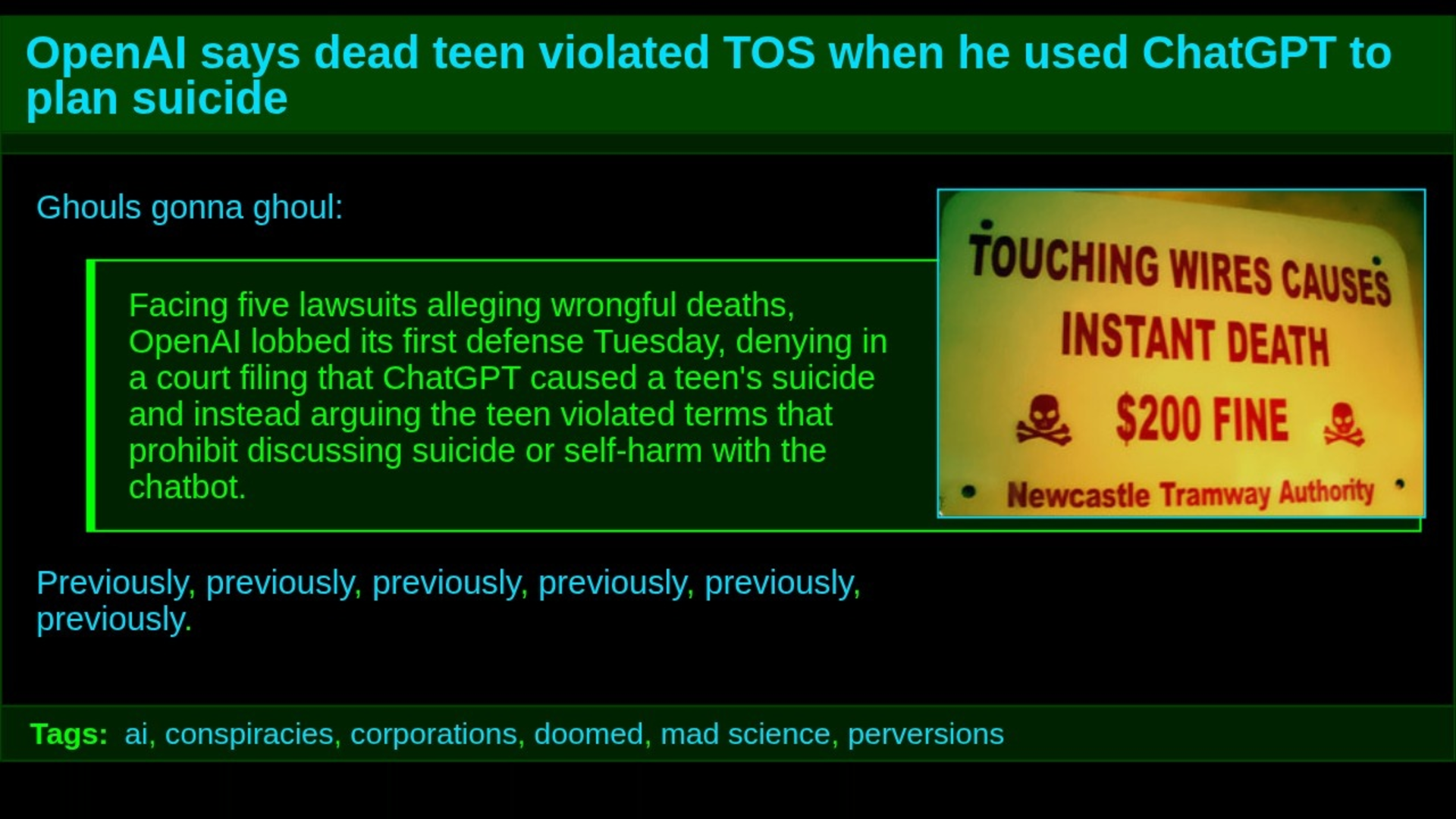
OpenAI says dead teen violated TOS when he used ChatGPT to plan suicide.
Ghouls gonna ghoul: Facing five lawsuits alleging wrongful deaths, OpenAI lobbed its first defense Tuesday, denying in a court filing that ChatGPT caused a teen's suicide and...
https://jwz.org/b/ykxy
 1
2
0
1
2
0
Jarkko Sakkinen
jarkko
Edited 6 months ago
@Foxboron Personally I think we don't have at this point a working model for spec. It's essentially a proprietary spec because a single Microsoft employee controls it. For me that means that is solely Microsoft controlled spec which is not right.
Up until that is changed, I cannot e.g. accept patches that would add policies for trusted keys. Not saying it should be located in kernel tree but there should some kind of shared repository to discuss about it and propose updates.
In kernel we support only public and private fields essentially with parent auth value and that is what it stays up until there is "community edition" of the spec.
E.g., for me IMA it might be useful if one could apply policy sealed trusted key as the anchor of trust.
Up until that is changed, I cannot e.g. accept patches that would add policies for trusted keys. Not saying it should be located in kernel tree but there should some kind of shared repository to discuss about it and propose updates.
In kernel we support only public and private fields essentially with parent auth value and that is what it stays up until there is "community edition" of the spec.
E.g., for me IMA it might be useful if one could apply policy sealed trusted key as the anchor of trust.
1
0
0
Jarkko Sakkinen
jarkko
Edited 6 months ago
@Foxboron Now I exactly recall why it is less important now. I do the trick inside cache i.e. I have separate encoding for cache policies, which retain e.g. information about parent's public field. That way I get most of the convenience without having to break the file format. At the time I did not even know that I will have vTPM cache eventually :-) Things happened quite fast (and without much sleep)
1
0
0
Jarkko Sakkinen
jarkko
@Foxboron It felt then important but not as much now :-) I'm happy to take one step back on that. I wrote the whole 20'ish kSLOC in three(ish) months and your opinions tend to develop during that process, especially what you see as a priority and what not. Looking at those mails, I don't really get all what I said anymore.
As per policy encoding, a working implementation is already an argument (IMHO) :-) And I know the implementation that I have now would be workable model for kernel as the execute could be implemented in 500-1000 lines of C code. Not something where I fight and I'm happy to hear what e.g., Lennart has to say about policy encoding.
My only strong opinion at this point is that I want to be at least aware of where things turn out as per policy encoding :-)
As per policy encoding, a working implementation is already an argument (IMHO) :-) And I know the implementation that I have now would be workable model for kernel as the execute could be implemented in 500-1000 lines of C code. Not something where I fight and I'm happy to hear what e.g., Lennart has to say about policy encoding.
My only strong opinion at this point is that I want to be at least aware of where things turn out as per policy encoding :-)
2
0
0
Jarkko Sakkinen
jarkko
Edited 6 months ago
@Foxboron
https://git.kernel.org/pub/scm/linux/kernel/git/jarkko/tpm2-tpmkey.git/commit/?id=89902ad0be70c3bc86a7c20fa42af1802e2b9e69
I guess for the time being this will address the current issues :-)
As per policy encoding I follow what exist now as in detail and as closely as currently is possible. I think it is still quite useful to have at least one working implementation as PoC or reference model.
https://git.kernel.org/pub/scm/linux/kernel/git/jarkko/tpm2-tpmkey.git/commit/?id=89902ad0be70c3bc86a7c20fa42af1802e2b9e69
I guess for the time being this will address the current issues :-)
As per policy encoding I follow what exist now as in detail and as closely as currently is possible. I think it is still quite useful to have at least one working implementation as PoC or reference model.
1
0
1
Jarkko Sakkinen
jarkko
full asn1 definition: https://git.kernel.org/pub/scm/linux/kernel/git/jarkko/tpm2-tpmkey.git/tree/src/asn1.rs
0
0
0
Jarkko Sakkinen
jarkko
Edited 6 months ago
@Foxboron I don't necessarily agree anymore to the word how I saw things then :-) The claim of endangering securiy was definitely wrong or at least a bit weak argument.
It's mostly about convenience (not about security) of not having to specify parent explitly, definitely something I can consider to drop. I also tested that openssl and tpm2-tools can handle files generated with my tool despite having that field.
Things that were not in the spec:
1. PolicyOr: I fully open code this including PolicyRestart calls.
2. Policy handle: I zero out this field in the encoded data.
I even looked at tpm2-tools and it does not really have anything at all for encoding arbitrary policies so I had to work on "without better knowledge". And without better knowledge this is the encoding I will use as basis for any kernel patch reviews or my own possible contributions.
It's mostly about convenience (not about security) of not having to specify parent explitly, definitely something I can consider to drop. I also tested that openssl and tpm2-tools can handle files generated with my tool despite having that field.
Things that were not in the spec:
1. PolicyOr: I fully open code this including PolicyRestart calls.
2. Policy handle: I zero out this field in the encoded data.
I even looked at tpm2-tools and it does not really have anything at all for encoding arbitrary policies so I had to work on "without better knowledge". And without better knowledge this is the encoding I will use as basis for any kernel patch reviews or my own possible contributions.
2
0
0
Jarkko Sakkinen
jarkko
Edited 6 months ago
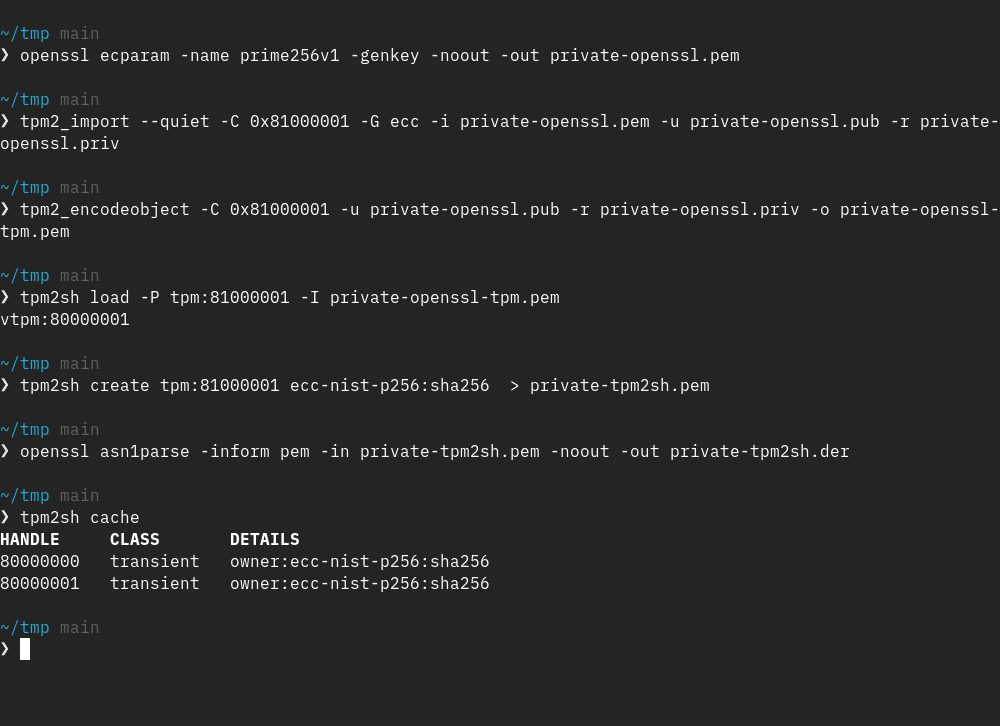
So the story with tpm2sh is that I only started it in August so that link feels like ancient history me in this fast-phased timeline :-)
If you have something other in mind and have good rationale for it, I want to align with that.The point is that tpm2sh is a reference model for me how kernel will handle the ASN.1 format.
If you have something other in mind and have good rationale for it, I want to align with that.The point is that tpm2sh is a reference model for me how kernel will handle the ASN.1 format.
2
0
0
Jarkko Sakkinen
jarkko
Edited 6 months ago
@Foxboron If possible, could you point out the part of the current version that don't right to you?
I'm proactively concerned about this because I need to know what we want for kernel in the long run.
We don't want two separate formats so it is better to address this issue rather sooner than later :-) I'm not hanging myself to my implementation. I'm just working without better information (perhaps).
Actually no need to even look at the source code (unless you really want to). Just describe what goes wrong and I'll check whether I need to address something or if it is already addressed.
I'm proactively concerned about this because I need to know what we want for kernel in the long run.
We don't want two separate formats so it is better to address this issue rather sooner than later :-) I'm not hanging myself to my implementation. I'm just working without better information (perhaps).
Actually no need to even look at the source code (unless you really want to). Just describe what goes wrong and I'll check whether I need to address something or if it is already addressed.
2
0
0