
Jarkko Sakkinen
jarkko
Edited 1 month ago
I created a shitty Python script in 2011 for indexing my photos and it has stuck intact since.
Since I'm finding myself using the same script I created a new C version with:
- xxhash32 hashing. Previous had md5, which was not great choice. I dropped the support.
- For JPEG content hashing instead of opaque file hashing.
- For CR2 still file hashing but I will change this soon.
- cp alike semantics and behaviour. Skips on collision (instead of overwriting).
- I created Debian packaging files but no energy to move this forward.
- Neither sys_read nor sys_write calls ;-)
Not actually proud of the last bullet.
There's this weird "tape drive cult" still going on strong in the user space.
Now the torch has been taken by the agents and they carry worst of the 70s to the future generations and onward.
Future plans in less than five years:
1. Fix content hashing for CR2.
2. smb:// (with libsmbclient)
3. ssh:// (with libssh)
I'll put out my old backup tool adhoc-backup also out again. It was originally in bash but out of curiosity wrote the new version with Zig. It's not great but I use it all the time and release it soon'ish :-)
Since I'm finding myself using the same script I created a new C version with:
- xxhash32 hashing. Previous had md5, which was not great choice. I dropped the support.
- For JPEG content hashing instead of opaque file hashing.
- For CR2 still file hashing but I will change this soon.
- cp alike semantics and behaviour. Skips on collision (instead of overwriting).
- I created Debian packaging files but no energy to move this forward.
- Neither sys_read nor sys_write calls ;-)
Not actually proud of the last bullet.
There's this weird "tape drive cult" still going on strong in the user space.
Now the torch has been taken by the agents and they carry worst of the 70s to the future generations and onward.
Future plans in less than five years:
1. Fix content hashing for CR2.
2. smb:// (with libsmbclient)
3. ssh:// (with libssh)
I'll put out my old backup tool adhoc-backup also out again. It was originally in bash but out of curiosity wrote the new version with Zig. It's not great but I use it all the time and release it soon'ish :-)
 0
0
 0
0
 1
1
Jarkko Sakkinen
jarkko
I don't know why I did not like it before but finally found a companion for mc: nnn :-)
0
0
0
Jarkko Sakkinen
jarkko
It will be painful experience to switch my root 4096-bit RSA PGP key so better to time it for quantum safety.
What is the quantum safe mainstream PGP key type, which would be also kernel.org compatible pick?
What is the quantum safe mainstream PGP key type, which would be also kernel.org compatible pick?
0
1
1
Jarkko Sakkinen
jarkko
Edited 1 month ago
MS-DOS indie gamedev, demoscene and similar "oldschool" forums usually recommend one of these options:
1. DJGPP
2. Turbo C++
3. Watcom C/C++
I possess MiSTeR FPGA with ao486 core so thought that would be a cool target to play a bit with but I need a development environment.
So... I created a development kit repository, providing tools to create MS-DOS COM an EXE files with the current GCC. It also provides ao486-simulation configs for dosbox-x and x86box. Finally it has a QEMU launcher emulating 486 SX 33 MHz, which matches ao486.
And yes, it's GCC + GAS thing plain and simple. I'm not really familiar with nasm etc. Before GAS it was TASM (Turbo Assembler) :-) Important thing here is that it has a C orchestrator and does not require FASM to provide MZ stub.
AKA edit-compiler-run delivered :-)
As a test run I have a test program does only some silly graphics but does give 486 a good test run given that:
1. 486 optimized codebase with a mentionable portion assembly (and I really did enjoy this).
2. Weird display mode in 320x240 256 color resolution and page flpping.
3. Configures memory to flat realmode (aka "unreal mode") and piggybacks lua-precalculated texture and palette to an additional .rodata_32 section.
Will be out in the foreseeable future...
#MiSTeR #FPGA #Ao486 #DOS #486
1. DJGPP
2. Turbo C++
3. Watcom C/C++
I possess MiSTeR FPGA with ao486 core so thought that would be a cool target to play a bit with but I need a development environment.
So... I created a development kit repository, providing tools to create MS-DOS COM an EXE files with the current GCC. It also provides ao486-simulation configs for dosbox-x and x86box. Finally it has a QEMU launcher emulating 486 SX 33 MHz, which matches ao486.
And yes, it's GCC + GAS thing plain and simple. I'm not really familiar with nasm etc. Before GAS it was TASM (Turbo Assembler) :-) Important thing here is that it has a C orchestrator and does not require FASM to provide MZ stub.
AKA edit-compiler-run delivered :-)
As a test run I have a test program does only some silly graphics but does give 486 a good test run given that:
1. 486 optimized codebase with a mentionable portion assembly (and I really did enjoy this).
2. Weird display mode in 320x240 256 color resolution and page flpping.
3. Configures memory to flat realmode (aka "unreal mode") and piggybacks lua-precalculated texture and palette to an additional .rodata_32 section.
Will be out in the foreseeable future...
#MiSTeR #FPGA #Ao486 #DOS #486
0
2
6
Jarkko Sakkinen
jarkko
Edited 1 month ago
It's incredibly slow progress to get this basic UI stuff ongoing for a daw. That said, this will pay back with complex UI views daws tend to have such as track mixer and arrangement.
I've played mindgames what if I would leverage cairo or similar library, and really weighted that option with critical mindset. Then when looking deeper I cannot really guarantee same way latency as if I control rendering surface. The quality of the whole app would suffer by a factor.
Finally, a DAW can have however many data points on display animating at the same time, which is already with custom UI framework a technical challenge to render properly.
Based on these conclusions I rather spend hour or two a day doing basic UI stuff from scratch with no progress for few weeks, month or even longer than do that. It's sucks now but conditions at least increasingly will get better.
Leveragng feels attractive at first but is a route where conditions will only get increasingly worse.
I've played mindgames what if I would leverage cairo or similar library, and really weighted that option with critical mindset. Then when looking deeper I cannot really guarantee same way latency as if I control rendering surface. The quality of the whole app would suffer by a factor.
Finally, a DAW can have however many data points on display animating at the same time, which is already with custom UI framework a technical challenge to render properly.
Based on these conclusions I rather spend hour or two a day doing basic UI stuff from scratch with no progress for few weeks, month or even longer than do that. It's sucks now but conditions at least increasingly will get better.
Leveragng feels attractive at first but is a route where conditions will only get increasingly worse.
0
0
2
Jarkko Sakkinen
jarkko
It's awkward but all "similarity search" type of thing options are actually really bad. So I'll do my audio sample indexing engine. I.e. a search like e.g., in Splice.
It's not very complicated to do a basic one, and it can be easily implemented first as a separate application.
It's not very complicated to do a basic one, and it can be easily implemented first as a separate application.
0
0
0
Jarkko Sakkinen
jarkko
(the background pic is ripped off from internet but is like 400-500m away from my front door :-))
0
0
0
Jarkko Sakkinen
jarkko
Edited 1 month ago
Do I regret writing that driver? Absolutely not. Without writing it I would know nothing about dma-buf. Now I know it from end to end :-) It cannot be useless wisdom I believe...
1
1
4
Jarkko Sakkinen
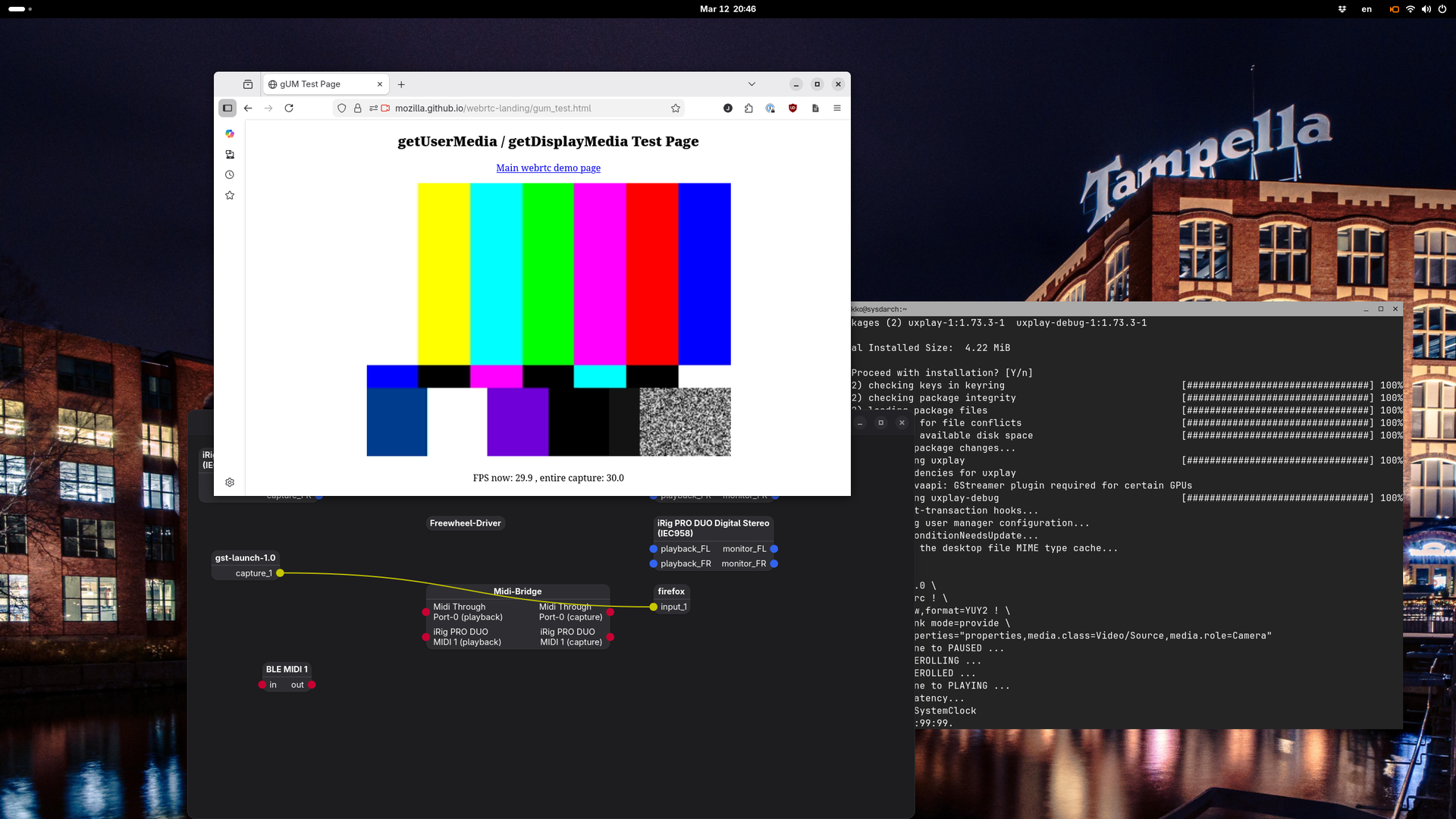
jarkkoOK so you can without v4l2loopback.
Smoke test:
gst-launch-1.0 \
    videotestsrc ! \
    video/x-raw,format=YUY2 ! \
    pipewiresink mode=provide \
    stream-properties="properties,media.class=Video/Source,media.role=Camera"
iPhone/Airplay:
uxplay -vs 0 -vrtp "config-interval=1 ! udpsink host=127.0.0.1 port=6000"

gst-launch-1.0 -v \
  udpsrc port=6000 caps="application/x-rtp,media=video,clock-rate=90000,encoding-name=H264,payload=96" ! \
  rtph264depay ! decodebin ! videoconvert ! \
  video/x-raw,format=YUY2 ! \
  pipewiresink mode=provide \
  stream-properties="properties,media.class=Video/Source,media.role=Camera,node.description=iPhone Camera"
Test page used: mozilla.github.io/webrtc-landing/gum_test.html
In Firefox the config option you’re looking for is called media.webrtc.camera.allow-pipewire.
 3
1
2
3
1
2
Jarkko Sakkinen
jarkko
@ethorsoe It's weird. I've looked up on Matrix like every five years and there hasn't been a single client to consider even as half-decent. There's no like "user experience".
Like even as archaic as mutt there's really well considered user experience and that's why it is so effective (and e.g., I still use it).
Like even as archaic as mutt there's really well considered user experience and that's why it is so effective (and e.g., I still use it).
0
0
0
Jarkko Sakkinen
jarkko
Edited 1 month ago
And not understanding the function, up- and downsides etc. of different ways the license open source software gets people ripped off these days.
And that's why e.g. Linux self-governs it so well because it has a proper license enforced legal framework to do so.
And that's why e.g. Linux self-governs it so well because it has a proper license enforced legal framework to do so.
0
0
0
Jarkko Sakkinen
jarkko
Does kernel.org have Matrix? This use would be really mainly for kernel stuff.
And actually if I want personal Matrix, I'd like to create a separate one for that.
And actually if I want personal Matrix, I'd like to create a separate one for that.
1
0
1
Jarkko Sakkinen
jarkko
RISC-V with MMU has neither complete spec: https://marcin.juszkiewicz.com.pl/2026/03/10/risc-v-is-sloooow/
0
0
0
Jarkko Sakkinen
jarkko
@pinkforest LGPL terms are technically very hard to implement when using Rust. How the linking works enforces GPL to anything using that dependency, even if you purposely wanted to use LGPL+ to allow fair even proprietary use (like e.g., ffmpeg).
1
0
0
Jarkko Sakkinen
jarkko
Edited 1 month ago
@pinkforest OK so how does it allow to use copyleft licenses effectively in those tiny units? I'm lost with this talk about storage space and runtime overhead, which have absolutely nothing to do with the topic. This is about IP protection e.g. with LGPL.
1
0
0
Jarkko Sakkinen
jarkko
Edited 1 month ago
For open source to surive, I think there should be radical shift towards wider use of copyleft licenses. This is the reality now, and it is better to accept it. And BTW, I was never a huge GPL advocate before.
How to tackle this with Rust and especially cargo, is an open question that needs to be resolved.
Throwing one potential solution: theoretically cargo could detect LGPL in dependency chains and make DSOs of these crates, which would be piggybacked into a virtual filesystem in the executable.
I'm not sure tho does that still comply for LGPL 2.1 when used e.g., in proprietary context.
There's also ABI work ongoing to get a stable DSO ABI for Rust but perhaps distribution problem could be resolved without resolving the ABI problem?
How to tackle this with Rust and especially cargo, is an open question that needs to be resolved.
Throwing one potential solution: theoretically cargo could detect LGPL in dependency chains and make DSOs of these crates, which would be piggybacked into a virtual filesystem in the executable.
I'm not sure tho does that still comply for LGPL 2.1 when used e.g., in proprietary context.
There's also ABI work ongoing to get a stable DSO ABI for Rust but perhaps distribution problem could be resolved without resolving the ABI problem?
2
1
4