
Jarkko Sakkinen
jarkko
 1
1
 0
0
 1
repeated
1
repeated

grepe
grepe@ieji.desome time ago i (half) joked that the only job #llm can replace outright is the CEO.
today i attended an earnings call where a synthetised voice of our CEO read multi-page long table of numbers from an official financial document, according to a script prepared by claude, over a single slide titled "company earnings 2025" - to a room full of employees who commuted to the office to watch it in person. there was no management present or even shown on the screen.
it was the most disturbed dystopian fucking thing i've experienced in my career of working for soul-crushing corporations.
0
12
2
repeated
The cat is out of the box: @matrix is looking for a new Thib!
If you think you can be a good fit for the role, please send me an email explaining why and attach your CV.
If you tick most of the boxes but not all, please reach out nonetheless. It’s a tall order, but we have fantastic volunteers and a great handbook to help you settle into the role.
0
10
0
repeated

Lennart Poettering
pid_eins@mastodon.social4️⃣ Here's the 4th post highlighting key new features of the upcoming v260 release of systemd. #systemd260 #systemd
When running code from OS trees, for example in containers, or when booting a full OS in a VM or on bare-metal it's often very useful to put together the basic OS from multiple overlayfs-style layers (directory-backed or backed by DDIs), plus some additional bind mounts, and possibly a tmpfs or two mounted to the right places to get ephemeral or partially ephemeral behaviour.
1
3
0
Jarkko Sakkinen
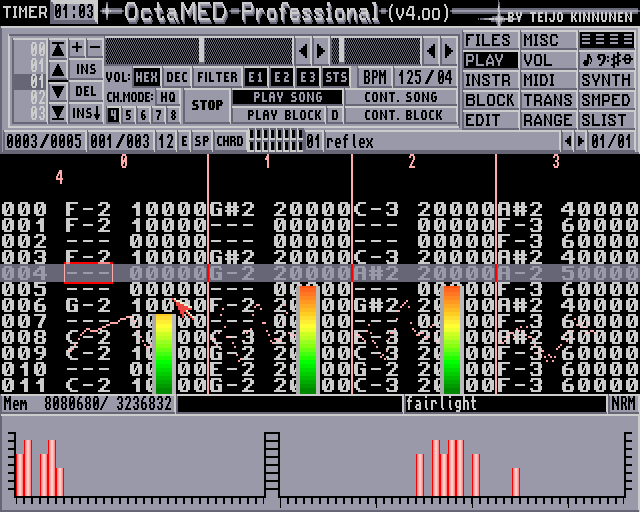
jarkko1. Octamed was made by a Finn Teijo Kinnunen.
2. Had major share on invention of such electronic music genres at their epoch such as breakbeat, jungle and drum'n'bass.
3. Still widely used as it does the job and has predictability unreachable on a signal chain with adaptive latency prevention algorithms, and especially with hardware samplers and such this makes ones life better.
4. I like it too a lot, it's great for what it does :-)
That is next 6 months at least because I want my tracker to level that I can do a full track with no other tools, and it is surprising how bottomless pit different usage patterns are (and not necessarily bugs, something just works or doesn't). And now that I actually have really good design and implementation for the engine it makes me less eager to less, it's fun to try things out :---)
#octamed #amiga
 2
0
4
2
0
4
Jarkko Sakkinen
jarkko
0
0
0
Jarkko Sakkinen
jarkko1. ttt --backend software: MiniFB + software
2 ttt --backend vulkan: Vulkan (Vk*) + GLSL
3. Input arrives always through MiniFB shenanigans.
MiniFB enables e.g., MS-DOS :-)
https://github.com/emoon/minifb
0
0
0
Jarkko Sakkinen
jarkkoEach tracks are already internally equal but each of the 16 tracks will receive in addition 3-band mixer and couple of inserts i.e. copying my favorite mobile DAW Caustic: https://archive.org/details/caustic3an
Yeah and as per synthesis curvature to envelopes, which like major headache in Polyend...
There's four synths in total:
1. Sampler with granular, slicing and rea-time timestrech (https://bungee.parabolaresearch.com/).
2. Wavetable with two oscillators, FM and overall all the shitty edm vomit :-)
3. Analog with 303 and Moog emulation, and less pecial SV12 and SV24 sub bass not so interesting analog emulations (but more useful as tools).
4. Drum hit synthetizer with 808, 909, 707 emulations and kick synthetizer.
This project started by accident during Fall when I was thinking that it would be nice to do a tracker but I will never get pattern editor done because it is suprsingly complex thing. I ended up doing that in 1-2 months without thinking much about it and without sound. Once I had that other stuff has formed "organically" :-)
I.e. this is a baseline. I will likely release this with GPLv3 license "within a year" but I have no rush because this is just sidekick activity...
1
0
0
Jarkko Sakkinen
jarkko
0
0
0
Jarkko Sakkinen
jarkkoThere is cdynlib but is also ecosystem/culture question. I.e. stuff that I don't want to sacrifice for AI, I don't do with Rust :-)
2
1
2
Jarkko Sakkinen
jarkkoI'm going to interpret the filter setting by having two synth engines internally:
1. SV12/SV24: use SH-ACD engine.
2. RD3: use TB-ACD engine.
SH-ACD is something like SH-101'esque and along the lines of hardware's timbre.
TB-ACD is my 303 emulator :-)
That way I get most (in the sense timbre palette) of that setting and can glue in my 303...
0
0
0
Jarkko Sakkinen
jarkkoIt's the moment in my life when you have to make my own 303 🤷
0
0
0
Jarkko Sakkinen
jarkko
0
0
0
Jarkko Sakkinen
jarkkoWhy C version is more stable:
1. If there is a segafault in a C program, for user space program, the full disclosure of the bug takes me like less than 20 minutes, with or without symbols. The binary is simple and as per code generated C is the most WYSIWYG language ever.
2. I can go absolutely sick in QA torture of the executable. There's so many ways you can bomb a C binary and trace everything in eBPF detail if you want, you can symbolic execute it with clang-tidy, Valgrind it etc.
I.e. while there are no federated laws the net result is still favorable for C at least in this project. I'm glad I started this rewrite :-)
1
0
2
Jarkko Sakkinen
jarkko
0
0
1
Jarkko Sakkinen
jarkkoIt looks still quite crappy although it is gradually improving. In Rust I use ab_glyph crate :-)
It's good because that keeps me doing stuff instead of publishing stupid videos so neither really consuming much energy on it yet :-)
0
0
0
Jarkko Sakkinen
jarkko1. Game engine alike in-app UI framework.
2. MiniFB supports even MS-DOS thus serving best for my downscaling needs and makes most value of the C rewrite :-)
3. For a DAW you cannot use e.g. SDL_Audio anyhow. I have my own audio stack using RT scheduling and memlock and directly using Pipewire.
4. It's import ready library in its simplicity i.e. one dependency less for me.
In Rust PoC I moved to SDL3 from minifb-rust but in the current situation the switch is quite obvious. I'll do it when I migrate on using Vulkan for setting up GLSL contexts :-)
MiniFB is amazing little piece of code: https://github.com/emoon/minifb
0
0
0
repeated


Jarkko Sakkinen
jarkkoLast time I did anything resembling this was when using FPU to divide 1/w while ALU is linearly interpolating the texture (on Pentium which has also nice and fast ALU pipeline, a leap over 486). This used to be common approach for software rendered perspective corrected texture mapping.
1
0
0
Jarkko Sakkinen
jarkko
0
0
0