
Posts
197Following
421Followers
350
 repeated

Fabio Manganiello
fabio@manganiello.social
Why Bell Labs worked so well, and could innovate so much, while today’s innovation, in spite of the huge private funding, goes in hype-and-fizzle cycles that leave relatively little behind, is a question I’ve been asking myself a lot in the past years.
And I think that the author of this article has hit the nail on its head on most of the reasons - but he didn’t take the last step in identifying the root cause.
What Bell Labs achieved within a few decades is probably unprecedented in human history:
They employed folks like Nyquist and Shannon, who laid the foundations of modern information theory and electronic engineering while they were employees at Bell.
They discovered the first evidence of the black hole at the center of our galaxy in the 1930s while analyzing static noise on shortwave transmissions.
They developed in 1937 the first speech codec and the first speech synthesizer.
They developed the photovoltaic cell in the 1940, and the first solar cell in the 1950s.
They built the first transistor in 1947.
They built the first large-scale electronic computers (from Model I in 1939 to Model VI in 1949).
They employed Karnaugh in the 1950s, who worked on the Karnaugh maps that we still study in engineering while he was an employee at Bell.
They contributed in 1956 (together with AT&T and the British and Canadian telephone companies) to the first transatlantic communications cable.
They developed the first electronic musics program in 1957.
They employed Kernighan, Thompson and Ritchie, who created UNIX and the C programming language while they were Bell employees.
And then their rate of innovation suddenly fizzled out after the 1980s.
I often hear that Bell could do what they did because they had plenty of funding. But I don’t think that’s the main reason. The author rightly points out that Google, Microsoft and Apple have already made much more profit than Bell has ever seen in its entire history. Yet, despite being awash with money, none of them has been as impactful as Bell. Nowadays those companies don’t even innovate much besides providing you with a new version of Android, of Windows or the iPhone every now and then. And they jump on the next hype wagon (social media, AR/VR, Blockchain, AI…) just to deliver half-baked products that (especially in Google’s case) are abandoned as soon as the hype bubble bursts.
Let alone singlehandedly spear innovation that can revolutionize an entire industry, let alone make groundbreaking discoveries that engineers will still study a century later.
So what was Bell’s recipe that Google and Apple, despite having much more money and talented people, can’t replicate? And what killed that magic?
Well, first of all Bell and Kelly had an innate talent in spotting the “geekiest” among us. They would often recruit from pools of enthusiasts that had built their own home-made radio transmitters for fun, rather than recruiting from the top business schools, or among those who can solve some very abstract and very standardized HackerRank problems.
And they knew how to manage those people. According to Kelly’s golden rule:
How do you manage genius? You don’t
Bell specifically recruited people that had that strange urge of tinkering and solving big problems, they were given their lab and all the funding that they needed, and they could work in peace. Often it took years before Kelly asked them how their work was progressing.
Compare it to a Ph.D today who needs to struggle for funding, needs to produce papers that get accepted in conferences, regardless of their level of quality, and must spend much more time on paperwork than on actual research.
Or to an engineer in a big tech company that has to provide daily updates about their progress, has to survive the next round of layoffs, has to go through endless loops of compliance, permissions and corporate bureaucracy in order to get anything done, has his/her performance evaluated every 3 months, and doesn’t even have control on what gets shipped - that control has been taken away from engineers and given to PMs and MBA folks.
Compare that way of working with today’s backlogs, metrics, micromanaging and struggle for a dignified salary or a stable job.
We can’t have the new Nyquist, Shannon or Ritchie today simply because, in science and engineering, we’ve moved all the controls away from the passionate technical folks that care about the long-term impact of their work, and handed them to greedy business folks who only care about short-term returns for their investors.
So we ended up with a culture that feels like talent must be managed, even micromanaged, otherwise talented people will start slacking off and spending their days on TikTok.
But, as Kelly eloquently put it:
“What stops a gifted mind from just slacking off?” is the wrong question to ask. The right question is, “Why would you expect information theory from someone who needs a babysitter?”
Or, as Peter Higgs (the Higgs boson guy) put it:
It’s difficult to imagine how I would ever have enough peace and quiet in the present sort of climate to do what I did in 1964… Today I wouldn’t get an academic job. It’s as simple as that. I don’t think I would be regarded as productive enough.
Or, as Shannon himself put it:
I’ve always pursued my interests without much regard for final value or value to the world. I’ve spent lots of time on totally useless things.
So basically the most brilliant minds of the 20th century would be considered lazy slackers today and be put on a PIP because they don’t deliver enough code or write enough papers.
So the article is spot on in identifying why Bell could invent, within a few years, all it did, while Apple, despite having much more money, hasn’t really done anything new in the past decade. MBAs, deadlines, pseudo-objective metrics and short-termism killed scientific inquiry and engineering ingenuity.
But the author doesn’t go one step further and identify the root cause.
It correctly spots the business and organizational issues that exist in managing talent today, but it doesn’t go deeper into their economic roots.
You see, MBA graduates and CEOs didn’t destroy the spirit of scientific and engineering ingenuity spurred by the Industrial Revolution just because they’re evil. I mean, there’s a higher chance for someone who has climbed the whole corporate ladder to be a sociopath than there is for someone you randomly picked from the street, but not to the point where they would willingly tame and screw up the most talented minds of their generation, and try and squeeze them into a Jira board or a metric that looks at the number of commits, out of pure sadism.
They did so because the financial incentives have drastically changed from the times of Bells Labs.
The Bells Labs were basically publicly funded. AT&T operated the telephone lines in the US, paid by everyone who used telephones, and they reinvested a 1% tax into R&D (the Bells Labs). And nobody expected a single dime of profits to come out from the Bells Labs.
And btw, R&D was real R&D with no strings attached at the time. In theory also my employer does R&D today - but we just ended up treating whatever narrow iterative feature requested by whatever random PM as “research and development”.
And at the time the idea of people paying taxes, so talented people in their country could focus on inventing the computer, the Internet or putting someone on the moon, without the pressure of VCs asking for their dividends, wasn’t seen as a socialist dystopia. It was before the neoliberal sociopaths of the Chicago school screwed up everything.
And, since nobody was expecting a dime back, nobody would put deadlines on talented people, nobody hired unqualified and arrogant business specialists to micromanage them, nobody would put them on a performance improvement plan if they were often late at their daily standups or didn’t commit enough lines of code in the previous quarter. So they had time to focus on how to solve some of the most complex problems that humans ever faced.
So they could invent the transistor, the programming infrastructure still used to this day, and lay the foundations of what engineers study today.
The most brilliant minds of our age don’t have this luxury. So they can’t revolutionarize our world like those in the 20th century did. Somebody else sets their priorities and their deadlines. They can’t think of moonshots because they’re forced to work on the next stupid mobile app that the next stupid VC wants to release to market so they could get insanely rich. They have to worry about companies trying to replace them with AI bots and business managers wanting to release products themselves by “vibe coding”, just to ask those smart people to clean up the mess they’ve done. They are seen as a cost, not as a resource.
Then of course they can’t invent the next transistor, or bring the next breakthrough in information theory.
Then of course all you get, after one year of the most brilliant minds of our generation working at the richest company that has ever existed, is just a new iPhone.
https://links.fabiomanganiello.com/share/683ee70d0409e6.66273547
 10
61
10
61
 1
repeated
1
repeated

Pete Alex Harris🦡🕸️🌲/∞🪐∫
petealexharris@mastodon.scot@eniko @amy @kryphos
None of the previous software hype cycles have turned out to be as inevitable as claimed at the time and none of the future ones will either.
Nobody is using expert systems written in Prolog to automatically generate all their software from natural language specifications, and nobody is "missing out" or "left behind" as a result of that never happening.
1
2
0
repeated

Tjeerd Royaards
royaards@newsie.socialThere is a sad and frustrating repetitiveness to my cartoons about Gaza, but still I think it's important to keep drawing them, just as it's important to keep sharing the images from Gaza.
Today's cartoon for Trouw: https://www.trouw.nl/cartoons/tjeerd-royaards~bcb45712/
#Gaza #Netanyahu #Israel #redline
 0
6
0
repeated
0
6
0
repeated

Netdev Conf
netdevconf@fosstodon.orgThe videos for @netdevconf 0x19 BoFs, tutorials and workshops are now up.
BoFs: https://www.youtube.com/playlist?list=PLrninrcyMo3Kv64a_2oRxnkdSMGQD_QRH
Tutorials: https://www.youtube.com/playlist?list=PLrninrcyMo3KroxpfNXOe2e6bc9WkzK8f
Workshops: https://www.youtube.com/playlist?list=PLrninrcyMo3J0P2pFNmbeOcQCf47pxMTf
Enjoy! #netdevconf
0
3
0
Toke Høiland-Jørgensen
tokeUnfortunately it wasn't recorded, but the slides are available here: https://github.com/xdp-project/xdp-project/blob/main/conference/LLC2025/honouring-the-life-of-dave-taht.pdf
"A man is not dead while his name is still spoken."
-Going Postal, Chapter 4 prologue
0
2
7
repeated
Jan Wildeboer 😷
jwildeboer@social.wildeboer.net
What I really don't like about the #DigitalSovereignty topic here in Europe is how it, again, just like with The Cloud, falls into the trap of nationalism instead of EU wide cooperation. I see national groups and lobbyists running around claiming that #DigitalSovereignty must have borders like countries. The German solution here, the Dutch solution here, the French doing something completely different. Interoperability ignored. People, let's not fall into that simplistic way of thinking again.
3
1
0
repeated

Peter Brodersen
brodersen@mastodon.cloudMy route planner for Denmark that refuses to drive on roads named after men is now online:
https://osrm.findvej.dk/nomales/
A couple of examples:
Carlsberg Byen:
https://osrm.findvej.dk/nomales/?z=16¢er=55.667353%2C12.533405&loc=55.665580%2C12.529242&loc=55.665435%2C12.530379&hl=da&alt=0
 0
5
0
repeated
0
5
0
repeated

 repeated

Joakim Melin
joacim@mastodon.melin.orgMeeting @bagder was great.
Such a nice and generous man. His work on cURL has such great value for the entire world.
All hail everyone who supports this great project.
Shame on the corporations using cURL who does not.
0
2
0
Toke Høiland-Jørgensen
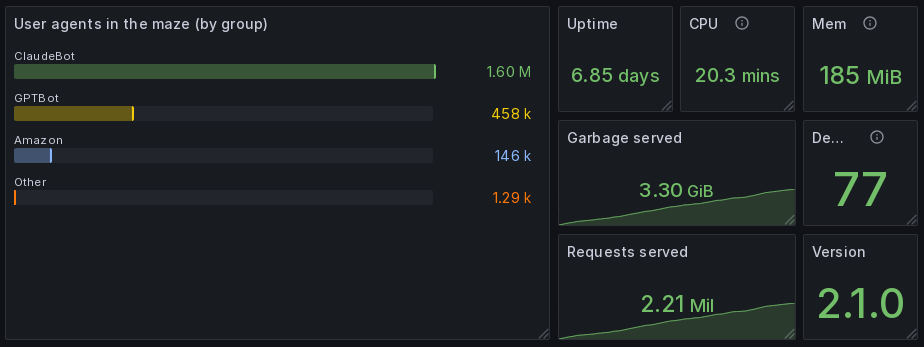
tokeSo I’ve been running Iocaine on one of my servers for just under a week now, and it’s already served 3.3 GiB of garbage to AI crawlers, Claudebot being the worst offender. This is ridiculous.
Setting up Iocaine itself was very straight forward, just another container image and a smallish config change in Nginx reverse proxy config. The dashboard needed a few tweaks for my version of Grafana, but is now happily ticking away. Can recommend!
 0
0
3
repeated
0
0
3
repeated

Timnit Gebru (she/her).
timnitGebru@dair-community.social@will This is a very good one, and why shouldn't you just believe these claims just because they tell you it was "better" because of a single "high" number on a benchmark.
1
1
0
repeated

Moof!
moof@cupoftea.socialOn this day 35 years ago, TGV unit 325 set the land speed record at 515.3 km/h on the LGV Atlantique.
This beat the previous record set by the same train on the 5th December 1989 of 482 km/h
Both these records managed to surpass the record set by an experimental ICE prototype in West Germany in 1988, which was 406.9 km/h on the Hannover-Würzburg line, thus establishing French engineering as superior to the German, at least on speed.
This record stayed current until 2007, when SNCF topped this with a TGV POS setting the new record at 568 and then 574,8 km/h.
TGV 325 is now decommissioned, and is kept at the Cité du Train in Mulhouse.



 3
6
0
repeated
3
6
0
repeated

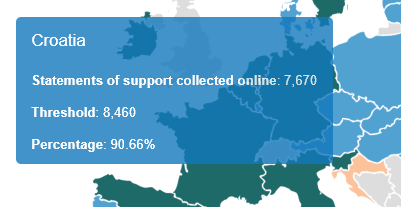
There are ~7 hours left in the EU citizens initiative ( https://eci.ec.europa.eu/043/public/#/screen/home ) asking the EU parliament to ban "conversion therapy" (pseudo-medical efforts to "cure" queers). It's at 1.2 million votes over 1 million; surplus votes are good because some votes may be disqualified, so EU nationals, it's still worth voting!
One thing I notice, it looks like DENMARK and CROATIA are *so* close to passing— under 1000 votes each. Does anyone here know how to inject a message in the Danish internet?

 3
6
0
repeated
3
6
0
repeated

noyb.eu
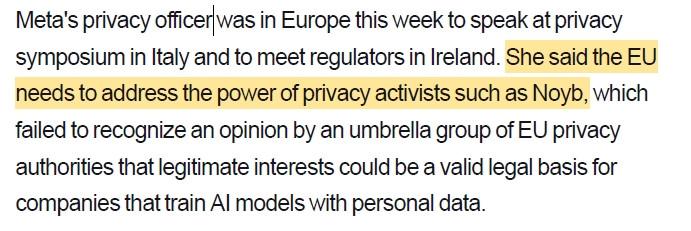
noybeu@mastodon.socialYou just know you're doing something right when #Meta 's data protection officer talks about your ‘power’ and how she wants the #EU to ban you from doing your work.🤡
Want to help us become even more ‘powerful‘? Click here to find out how: https://noyb.eu/en/support-us
Original Art: https://www.pixiv.net/en/artworks/55975367

 3
16
1
3
16
1
Toke Høiland-Jørgensen
tokeHaha, yup! Sometimes you gotta do things yourself if you want them done right 😃
0
0
1
Toke Høiland-Jørgensen
tokeHow about some swing classics from a contemporary band with a female vocalist who is also a swing dancer? :)
https://naomisdevils.bandcamp.com/
1
0
1
repeated

ahistorical immaterialist
jimbob@aus.socialI need to be very clear, that the push towards "vibe coding" - that is, deliberately deskilling people - is because AI code assistants are an (increasingly expensive) subscription service.
If you know how to code, you can just write Python, C, Java, R, PHP, whatever for free and make things. You may not own the tools of production, but at least you're not renting them.
If you have been deskilled so you only know how to vibe code, you will be paying for that privilege forever.
This also goes, by the way, for researchers who are starting to be convinced they don't need to learn how to be scientists anymore, because "the AI" can just do the science for them. Nope.
8
26
1
repeated

juliette
juliette@mastodon.greenOK, I'm going to hammer on this one. Five days might not seem like much to get 700,000 signature, but I've seen petitions get to 1 million in a day to save baby seals, so why not banning conversion therapy.
We have 4 countries above the threshold, but even if you're in those, your signature can make a different to reach the million.
Aside from that, we are nearing the threshold in the following countries:
Belgium
Slovenia
The Netherlands
Denmark
Germany
https://eci.ec.europa.eu/043/public/#/screen/home
3
13
0