
Posts
197Following
422Followers
354
 repeated

"Miss Movie Masochist"
socketwench@masto.hackers.town
Housemate:
"The existence of http and https implies the existence of http3, http: Resurrection, and http vs. Predator.
Discuss."
 1
9
1
9
 0
repeated
0
repeated

Tim Bray 🇨🇦
timbray@cosocial.caThis is some deeply weird and troubling shit. #GenAI
Agent Psychosis: Are We Going Insane? | Armin Ronacher's Thoughts and Writings
https://lucumr.pocoo.org/2026/1/18/agent-psychosis/
1
2
0
repeated

Mirko Swillus
mechko@chaos.socialDear FOSS Community 👋,
I’m researching Open Source funds and support programs that directly pay FOSS maintainers or contributors (not just offering mentorship), similar to the Fellowship program by @sovtechfund
I’m especially looking for programs that:
- are aimed at FOSS maintainers or contributors (not only students),
- focus on paid support and
- offer funding for at least 3 months.
If you know of any funds, organizations, or initiatives like this, please comment (or boost). Thanks :)
13
15
0
repeated

Viss
Viss@mastodon.socialcool, so there's a whole new github dork people can do: claude chatlogs.
they live in .claude/logs/ and are full text records of peoples entire conversations with claude
and they're ending up in public on github because i guess people arent adding them to .gitignore
happy monday! ai is going great!
2
12
0
repeated

VM (Vicky) Brasseur
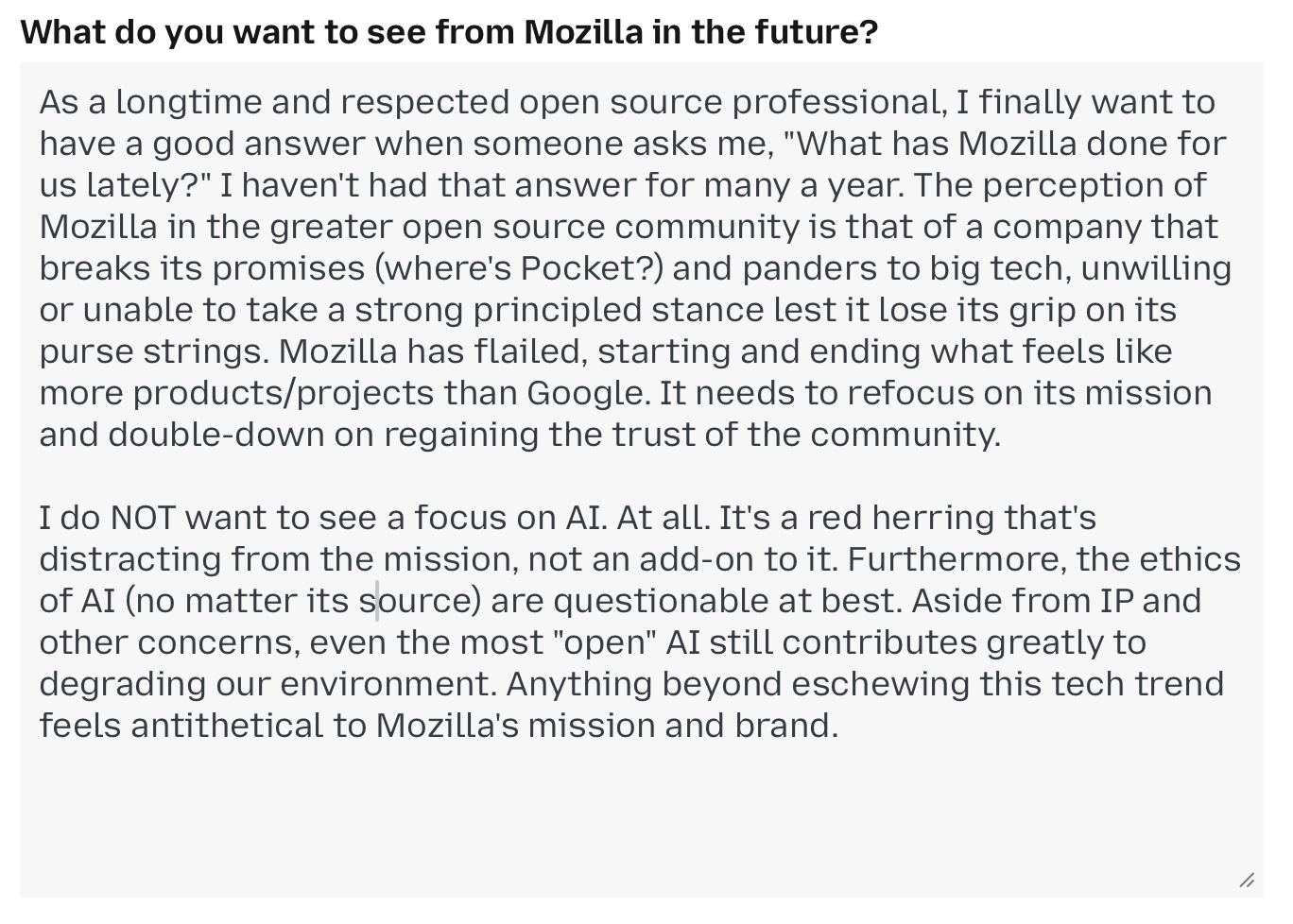
vmbrasseur@social.vmbrasseur.comMozilla wants your input. Please provide it.
https://mozillafoundation.tfaforms.net/201
Here's mine.
#OpenSource #OpenWeb #Privacy #AI
 6
26
1
repeated
6
26
1
repeated

Joe Brockmeier
jzb@hachyderm.ioA thought that popped into my head when I woke up at 4 am and couldn’t get back to sleep…
Imagine that AI/LLM tools were being marketed to workers as a way to do the same work more quickly and work fewer hours without telling their employers.
“Use ChatGPT to write your TPS reports, go home at lunchtime. Spend more time with your kids!” “Use Claude to write your code, turn 60-hour weeks into four-day weekends!” “Collect two paychecks by using AI! You can hold two jobs without the boss knowing the difference!”
Imagine if AI/LLM tools were not shareholder catnip, but a grassroots movement of tooling that workers were sharing with each other to work less. Same quality of output, but instead of being pushed top-down, being adopted to empower people to work less and “cheat” employers.
Imagine if unions were arguing for the right of workers to use LLMs as labor saving devices, instead of trying to protect members from their damage.
CEOs would be screaming bloody murder. There’d be an overnight industry in AI-detection tools and immediate bans on AI in the workplace. Instead of Microsoft CoPilot 365, Satya would be out promoting Microsoft SlopGuard - add ons that detect LLM tools running on Windows and prevent AI scrapers from harvesting your company’s valuable content for training.
The media would be running horror stories about the terrible trend of workers getting the same pay for working less, and the awful quality of LLM output. Maybe they’d still call them “hallucinations,” but it’d be in the terrified tone of 80s anti-drug PSAs.
What I’m trying to say in my sleep-deprived state is that you shouldn’t ignore the intent and ill effects of these tools. If they were good for you, shareholders would hate them.
You should understand that they’re anti-worker and anti-human. TPTB would be fighting them tooth and nail if their benefits were reversed. It doesn’t matter how good they get, or how interesting they are: the ultimate purpose of the industry behind them is to create less demand for labor and aggregate more wealth in fewer hands.
Unless you happen to be in a very very small club of ultra-wealthy tech bros, they’re not for you, they’re against you. #AI #LLMs #claude #chatgpt
11
19
0
repeated

K. Ryabitsev-Prime 🍁
monsieuricon
It's a neat little tool that lets maintainers "subscribe" to mailing lists without actually subscribing to mailing lists. Supports delivering to Gmail, IMAP, JMAP, local maildir, etc. Requires "lei" to do a lot of things, so make sure that's installed.
Lots of new features in this release, including `kgl track-subsystem` that will try to automatically set up lei queries based on the subsystem you're interested in.
Lots more testing needed of the new features, so will be happy if others try it out.
https://lore.kernel.org/tools/20260115-economic-uncovered-nuthatch-36e35b@lemur/T/#u
2
9
9
repeated

 repeated

Thorsten Leemhuis (acct. 1/4)
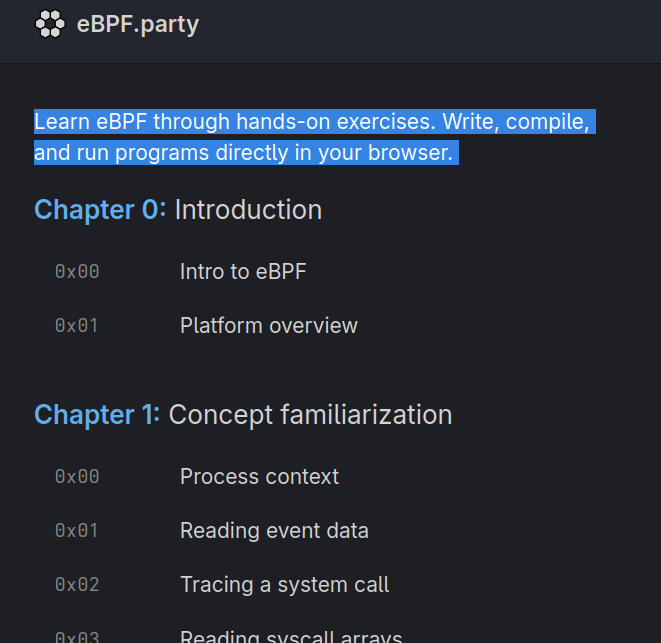
kernellogger@hachyderm.ioeBPF.party – Learn eBPF through hands-on exercises. Write, compile, and run programs directly in your browser:
#Linux #LinuxKernel #kernel #ebpf #bpf
 1
3
0
repeated
1
3
0
repeated

Liam @ GamingOnLinux 🐧🎮
gamingonlinux@mastodon.socialDev of Steam game 'Hardest' will delete it after new girlfriend made them realize AI is bad https://www.gamingonlinux.com/2026/01/dev-of-steam-game-hardest-will-delete-it-after-new-girlfriend-made-them-realize-ai-is-bad/
2
2
0
Toke Høiland-Jørgensen
tokeTo appear in a Linux release near you in ~12 week's time...
https://lore.kernel.org/r/176830261504.2192300.2198008591862995733.git-patchwork-notify@kernel.org
1
2
3
repeated

Pete Alex Harris🦡🕸️🌲/∞🪐∫
petealexharris@mastodon.scotI think the appearance of free software really broke the oligarch's brains. People are just giving away stuff that should be Shareholder Value? And we *can't* buy it off them and own it? People are just running a compiler whenever they like to make whatever they want without paying anyone?
The push to adopt LLM-powered code generation tools is so frenzied and desperate partly because it's a perceived solution to claw back ownership of the means of production into the Right Hands.
3
6
0
repeated

Existential Comics
existentialcomics@mastodon.socialThe Invention of Anarchism -
https://existentialcomics.com/comic/637
1
3
0
Toke Høiland-Jørgensen
tokeAlthough of course it's a bit ironic since the reason I'm calling them is that it seems that there *is* in fact a valley low enough to keep them from coming to me... 🤷
0
0
1
repeated

 🇪🇺
🇪🇺
 repeated

Thomas Depierre
Di4na@hachyderm.io"Have you considered going commercial yet!?!?!?" Yes and it is a bad idea. Here is why it is actually really hard to give money and support most FOSS projects. In a blogpost rant.
This is probably my second to last blog in that improptu serie about Hobbyists Maintainers, slowly reaching its conclusion of a model of Hobbyists Maintainers situation and how we can actually help them.
Because believe it or not, I know how to say something else than "no" or "it will not work".
3
10
0
repeated

Jeppe Bundsgaard på Mastodon
jeppe@uddannelse.social"Windows users keep losing files to OneDrive, and many don't know why | TechSpot"
Jeg opdagede forleden at min fars filer var flyttet til onedrive. Jeg troede at han havde godkendt et eller andet. Men nej, det har Microsoft gjort uden at spørge. Vi er enige om at det er tid til at flytte til linux.
Jeg fatter ikke hvordan I der bruger Windows, kan finde rundt og finder jer i at blive behandlet på den måde af Microsoft.
https://www.techspot.com/news/110848-onedrive-backup-feature-making-users-local-files-seemingly.html
0
2
0
repeated

David Chisnall (*Now with 50% more sarcasm!*)
david_chisnall@infosec.exchangeI would make a slightly different point, I think.
When I was at university, doing a degree in computer science, the first language they taught us was Pascal. The second was Prolog. I can’t remember which order the third and fourth were taught in, but they were Java and Haskell.
Of these, Java was the only one widely used in industry. In my subsequent career, I have rarely used any of these. But I have used the concepts I learned repeatedly.
The tools change. Eventually, modern IDEs will catch up with 1980’s Smalltalk in functionality. But the core concepts change far more slowly.
And this matters even more for school children, because they’re not doing a degree to take them on a path where the majority will end up as programmers, they’re learning a skill that they can use in any context.
I spent a little bit of time attached to the Swansea History of Computing Collection working to collect oral histories of early computing in Wales. Glamorgan university was the first to offer a vocational programming qualification. They had one day of access to a computer at the Port Talbot steelworks (at the time, the only computer in Wales) each week. Every week, the class would take a minibus to visit the computer. They would each take it in turns to run their program (on punch cards). If it didn’t work, they would try to patch to code (manually punching holes or taping over them) and would get to have another go at the end.
Modern programming isn’t really like that (though it feels like it sometimes). The compile-test cycle has shortened from a week to a few seconds. Debuggers let you inspect the state of running programs in the middle. Things like time-travel debugging let you see an invalid value in memory and then run the program backwards to see where the value was written!
But the concepts of decomposing problems into small steps, and creating solutions by composing small testable building blocks remain the same.
The hard part of programming hasn’t been writing the code since we moved away from machine code in punched tape. It’s always been working out what the real problem is and expressing it unambiguously.
In many ways, LLMs make this worse. They let you start with an imprecise definition of the problem and will then fill in the gaps based on priors from their training data. In a classroom setting, those priors will likely align with the requirements of the task. The same may be true if you’re writing a CRUD application that is almost the same as 10,000 others with a small tweak that you put in the prompt. But once it has generated the code then you need to understand that it’s correct. LLMs can generate tests, but unless you’re careful they won’t generate the right tests.
The goal isn’t to produce children who can write code. It’s to empower the children with the ability to turn a computer into a machine that solves their problems whatever those problems are and to use the kind of systematic thinking in non-computing contexts.
The latter of these is also important. I’ve done workflow consulting where the fact that the company was operating inefficiently would be obvious to anyone with a programming background. It isn’t just mechanical systems that have these bottlenecks.
And this should feed into curriculum design (the Computer Science Unplugged curriculum took this to an extreme and produced some great material). There’s no point teaching skills that will be obsolete by the time that the children are adults, except as a solvent for getting useful transferable skills into their systems. A curriculum should be able to identify and explain to students which skills are in which category.
(And, yes, I am still bitter my schools wasted so much time on handwriting, a skill I basically never use as an adult. If I hand write 500 words in a year, it’s unusual, but I type more than that most days)
2
1
0
repeated

🇳𝗮ꜟ𝖼𝘩
Naich@fosstodon.org@neil
I am constantly impressed by how good Immich is. It's not perfect - there was a bug which killed the server under certain conditions a couple of months ago, but the community quicky came up with a mitigation, and the fix came in an update a few days later.
0
1
0
repeated

Mojo ♻️
mojo@aus.socialCalling Wilcox’s cartoon “unacceptable” misunderstands both satire and journalism. Political cartoons are meant to be provocative, compressed and confronting. They exaggerate power relationships to expose hypocrisy and danger, not to offer polite balance.
This cartoon does exactly that. It highlights unchecked US imperial behaviour and the hollow language of “freedom and security” used by institutions like NATO while aggression proceeds regardless. Discomfort is not a flaw, it is the point.
If a cartoon criticising military power is deemed unacceptable simply because it offends those aligned with that power, then the problem is not the cartoon. It is a shrinking tolerance for dissent and satire in public debate.
Wilcox is doing a great job.
#politicalcartoons #satire #pressfreedom #imperialism #media #theage
 0
3
0
0
3
0