
Jarkko Sakkinen
jarkko
It's just that with C you can touch anything, and thus it is extreme levels fast discover how systems do when you poke them.
In kernel things are obviously different as there is just one thing your tickling ;-)
 2
2
 0
0
 3
3
Jarkko Sakkinen
jarkkoIt's a bit similar case as lsiommu, i.e. scripts that have been making my life worse for over 10 years and now I'm "reimagining" them ;-)
This way I get those wiped away from my backlog and learn something new in the process.
#zig #mutt #email
0
0
2
Jarkko Sakkinen
jarkkolsiommu provides now also json output:
❯ build/lsiommu | head -10
Group 000 Address 0000:00:07.1 Class 060400 ID 8086:9a25 Revision 01
Group 001 Address 0000:00:07.0 Class 060400 ID 8086:9a23 Revision 01
Group 002 Address 0000:00:02.0 Class 030000 ID 8086:9a49 Revision 01
Group 003 Address 0000:00:00.0 Class 060000 ID 8086:9a14 Revision 01
Group 004 Address 0000:00:04.0 Class 118000 ID 8086:9a03 Revision 01
Group 005 Address 0000:00:0a.0 Class 118000 ID 8086:9a0d Revision 01
Group 006 Address 0000:00:0d.0 Class 0c0330 ID 8086:9a13 Revision 01
Group 006 Address 0000:00:0d.2 Class 0c0340 ID 8086:9a1b Revision 01
Group 007 Address 0000:00:0e.0 Class 010400 ID 8086:9a0b Revision 00
Group 008 Address 0000:00:14.0 Class 0c0330 ID 8086:a0ed Revision 20

~/work/github.com/puavo-org/lsiommu master
❯ build/lsiommu --style json | head -10
{
        "iommu_groups": [{
                        "id":   0,
                        "devices":      [{
                                        "address":      "0000:00:07.1",
                                        "class":        "060400",
                                        "vendor":       "8086",
                                        "device":       "9a25",
                                        "revision":     "01"
                                }]
better not to tag 1.0.0 yet to leave room for command-line interface and output formatting tweaks although now it is “feature complete”.
0
0
0
Jarkko Sakkinen
jarkkohttps://github.com/puavo-org/lsiommu/blob/master/udev.c
does libudev have mechanism to get directly a packed representation?
#linux #udev #pci
0
0
1
Jarkko Sakkinen
jarkkoThis would be for testing Himmelblau on a VM and for that use and purpose create a fake TPM vendor CA. AFAIK, Himmelblau does not yet sign anything with attestation keys but there will be a day when it will, so better to be prepared.
#himmelblau #azure #tpm
0
0
0
Jarkko Sakkinen
jarkkoIt's quite light now with deps in all situations:
deps = [
dependency('argtable2'),
dependency('libudev'),
]
#linux #iommu #buildroot
0
1
0
Jarkko Sakkinen
jarkkothis came out pretty nice and clean
❯ git ls-files
.tokeignore
CHANGELOG.md
LICENSE
Makefile
README.md
down.c
down.h
iommu.c
iommu.h
log.c
log.h
lsiommu.1
main.c
main.h
meson.build
meson.options
strbuf.c
strbuf.h
util.h
#linux #iommu
 2
1
1
2
1
1
Jarkko Sakkinen
jarkko❯ wc -l *.c *.h
317 iommu.c
31 log.c
70 main.c
32 teardown.c
26 iommu.h
16 log.h
11 main.h
20 teardown.h
523 total
Not too bad considering that iommu.c has a heap tree and radix sort implementation (I dislike qsort for anything really)
RE: https://social.kernel.org/objects/96e13d6c-6be2-4180-9bbc-f4e3fbd6a38b
1
0
1
Jarkko Sakkinen
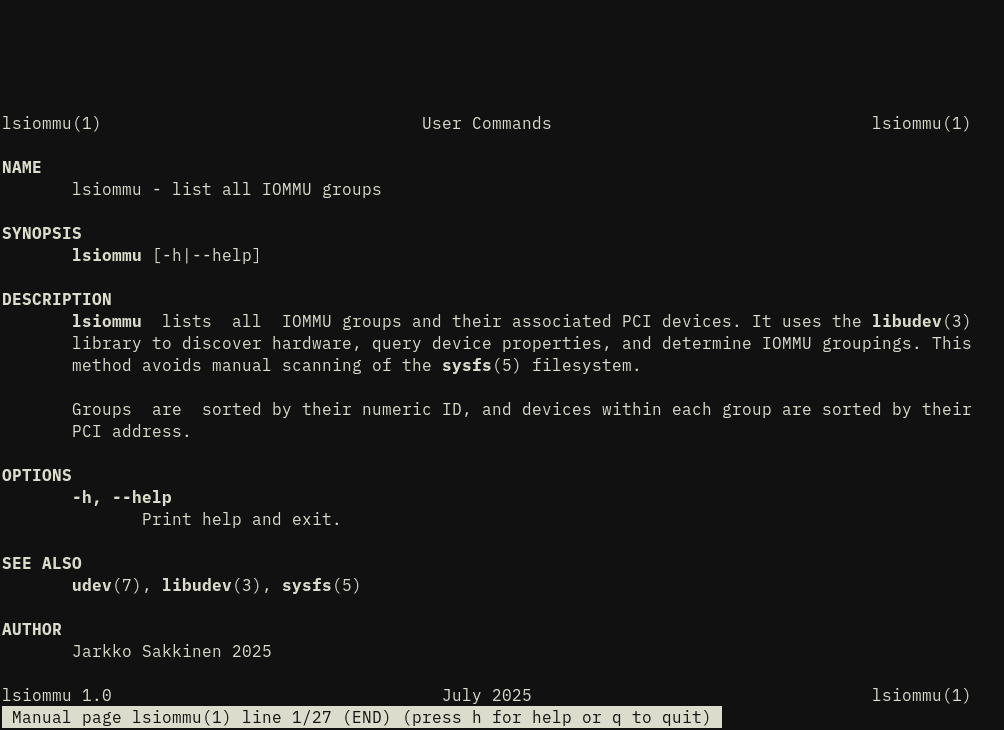
jarkkoI made lsiommu as I just wanted to get rid of the shitty combination of bash and python I had before:
~/work/staging/lsiommu master*
❯ build/lsiommu
IOMMU Group 0
	00:07.1 Class 060400: Vendor 8086 Device 9a25 [8086:9a25] (rev 01)
IOMMU Group 1
	00:07.0 Class 060400: Vendor 8086 Device 9a23 [8086:9a23] (rev 01)
IOMMU Group 2
	00:02.0 Class 030000: Vendor 8086 Device 9a49 [8086:9a49] (rev 01)
IOMMU Group 3
	00:00.0 Class 060000: Vendor 8086 Device 9a14 [8086:9a14] (rev 01)
IOMMU Group 4
	00:04.0 Class 118000: Vendor 8086 Device 9a03 [8086:9a03] (rev 01)
IOMMU Group 5
	00:0a.0 Class 118000: Vendor 8086 Device 9a0d [8086:9a0d] (rev 01)
IOMMU Group 6
	00:0d.0 Class 0c0330: Vendor 8086 Device 9a13 [8086:9a13] (rev 01)
	00:0d.2 Class 0c0340: Vendor 8086 Device 9a1b [8086:9a1b] (rev 01)
IOMMU Group 7
	00:0e.0 Class 010400: Vendor 8086 Device 9a0b [8086:9a0b] (rev 00)
IOMMU Group 8
	00:14.0 Class 0c0330: Vendor 8086 Device a0ed [8086:a0ed] (rev 20)
	00:14.2 Class 050000: Vendor 8086 Device a0ef [8086:a0ef] (rev 20)
IOMMU Group 9
	00:14.3 Class 028000: Vendor 8086 Device a0f0 [8086:a0f0] (rev 20)
IOMMU Group 10
	00:15.0 Class 0c8000: Vendor 8086 Device a0e8 [8086:a0e8] (rev 20)
IOMMU Group 11
	00:16.0 Class 078000: Vendor 8086 Device a0e0 [8086:a0e0] (rev 20)
IOMMU Group 12
	00:1d.0 Class 060400: Vendor 8086 Device a0b0 [8086:a0b0] (rev 20)
IOMMU Group 13
	00:1f.0 Class 060100: Vendor 8086 Device a082 [8086:a082] (rev 20)
	00:1f.3 Class 040100: Vendor 8086 Device a0c8 [8086:a0c8] (rev 20)
	00:1f.4 Class 0c0500: Vendor 8086 Device a0a3 [8086:a0a3] (rev 20)
	00:1f.5 Class 0c8000: Vendor 8086 Device a0a4 [8086:a0a4] (rev 20)
IOMMU Group 14
	55:00.0 Class 010802: Vendor 144d Device a808 [144d:a808] (rev 00)
Perhaps the most interesting implementation note is that it uses libudev for PCI discovery, instead of traversing sysfs (because the latter sucks).
Right and I made my own shitty teardown manager framwork:
/* SPDX-License-Identifier: GPL-3.0-or-later */
/*
 * Copyright(c) Opinsys Oy 2025
 */

#ifndef TEARDOWN_H
#define TEARDOWN_H

#include <libudev.h>

#define teardown(func) __attribute__((cleanup(func)))

void teardown_udev(struct udev **udev);
void teardown_udev_device(struct udev_device **dev);
void teardown_udev_enumerate(struct udev_enumerate **enumerate);

#endif /* TEARDOWN_H */
Dependencies:
❯ ldd build/lsiommu
	linux-vdso.so.1 (0x00007f083ccd5000)
	libargtable2.so.0 => /lib/x86_64-linux-gnu/libargtable2.so.0 (0x00007f083cc8a000)
	libudev.so.1 => /lib/x86_64-linux-gnu/libudev.so.1 (0x00007f083cc5c000)
	libsystemd.so.0 => /lib/x86_64-linux-gnu/libsystemd.so.0 (0x00007f083cb8c000)
	libc.so.6 => /lib/x86_64-linux-gnu/libc.so.6 (0x00007f083c9ab000)
	/lib64/ld-linux-x86-64.so.2 (0x00007f083ccd7000)
	libcap.so.2 => /lib/x86_64-linux-gnu/libcap.so.2 (0x00007f083c99f000)
	libgcrypt.so.20 => /lib/x86_64-linux-gnu/libgcrypt.so.20 (0x00007f083c856000)
	liblzma.so.5 => /lib/x86_64-linux-gnu/liblzma.so.5 (0x00007f083c827000)
	libzstd.so.1 => /lib/x86_64-linux-gnu/libzstd.so.1 (0x00007f083c76b000)
	liblz4.so.1 => /lib/x86_64-linux-gnu/liblz4.so.1 (0x00007f083c745000)
	libgpg-error.so.0 => /lib/x86_64-linux-gnu/libgpg-error.so.0 (0x00007f083c71d000)
I can throw this to some Git repository if anyone is interested any of this. It’s really just “by me for me”, but I neither mind sharing it.
2
2
2
Jarkko Sakkinen
jarkkoconsolidated my linux pr process to a a repo, so that i can improve it over time :-) i tried printf first to generate substitutions for the mustache based email template but jq is needed here just purely for escaping the summary generated by git request-pull.
https://git.kernel.org/pub/scm/linux/kernel/git/jarkko/linux-pull-request.git/tree/?h=main
0
0
0
Jarkko Sakkinen
jarkkoThis not only fixes the issue macOS but there is also a native Linux version. Further, it happened to be 60% discount :-)
0
0
0
Jarkko Sakkinen
jarkkohttps://github.com/KokaKiwi/rust-hex/pull/83
It adds decode_in_slice() function, which decodes the hex string within the input buffer overwriting the contents. It is with ugly but still useful for e.g., fast and constrained protocol implementations.
Just came as surprise because the PR was made almost two years ago...
#rust #rustlang
1
0
6
Jarkko Sakkinen
jarkkohttps://lore.kernel.org/linux-integrity/aGffUrDSjNH6w6rB@kernel.org/
Enjoyment did come like e.g, for "winning the argument". Instead it s fun to do this type of comparisons for the cause and effect of choices to the resulting binary :-) I did honestly did not know the correct answer beforehand.
Reviewing random day-by day patches can be boring. If I have some extra bandwidth this how I usually spice it up just a bit.
#linux #kernel #arm
0
0
1
Jarkko Sakkinen
jarkkohttps://github.com/himmelblau-idm/himmelblau/pull/592
#systemd #himmelblau
0
0
0
Jarkko Sakkinen
jarkkohttps://www.youtube.com/watch?v=gHnG8KZpYg4
Intune is a technology where open source community needs to be clear on that "no, microsoft, edge + a shitty daemon running on a subset of linux distributions is not acceptable".
#microsoft #intune #himmelblau #samba
0
0
1
Jarkko Sakkinen
jarkkofixed up by:
sudo rm -rv /var/lib/apt/lists/*
#debian
0
1
0
Jarkko Sakkinen
jarkkoAs of today, the project is based on reverse engineering Apple and Windows clients, as the Intune API for Linux that Edge uses in tandem with intune-portal service does not have machine authentication.
"Microsoft Intune App" is based on chain of Microsoft binaries scavenging requested data from a system (Edge and intune-portal).
This blocks essentially the management tools for organization Linux machines by large.
Himmelblau on the other hand is a piece of middleware that manages the computer through the power cycle system-wide for the whole system, and thus can provide both boot-time initialization (himmelblaud) and reoccuring updates needed to maintain the trust (himmelblaud-tasks), such as Kerberos ticket and that kind of stuff.
0
0
0
Jarkko Sakkinen
jarkkoWARNING: unnecessary cast may hide bugs, see http://c-faq.com/malloc/mallocnocast.html
Tried to fix it but also https is broken. It's also quite common mistake, meaning that it pushes insecure in volumes to developers.
#linux #kernel
1
0
0